
Church payroll and the minister's W-2: which products can produce one
A minister is an employee for income tax and self-employed for Social Security. The four gates a payroll product has to pass, prices read 29 July 2026, and the vendors that refused.

A church signs up for payroll software in September. The wizard asks for names, pay rates, a bank account, and a state. Nobody at the church notices the question it never asked. The first pay run goes out, Social Security and Medicare come off the pastor’s check like they come off everyone else’s, and the software keeps doing that for four months without complaining once. Nothing looks wrong until a W-2 prints in January with figures in boxes 3 and 5 that the IRS instructions say should be empty.
That is not a rare configuration error. It is the default behavior of a product built for a business, applied to a worker the tax code treats two ways at once. A minister employed by a congregation is a common-law employee for income tax and self-employed for Social Security, which means the same paycheck follows two different rulebooks, and a payroll engine that models one worker type cannot express it.
Nine payroll products are named below, and each one was asked the same question through its own published pages. Two of them print a rate card, which is why only three lines appear on the cost chart. Four would not serve a page to our requests at all, and that is recorded rather than filled in. This sits alongside church accounting software that keeps designated funds straight, which owns the ledger and the fund report. This page owns the payroll and the form.
Should a pastor get a 1099 or a W-2?
A minister employed by a church receives a W-2. The IRS states that “if a congregation employs you for a salary, you’re generally a common-law employee of the congregation and your salary is considered wages for income tax withholding purposes.” The same person is self-employed for Social Security and Medicare. One worker, two treatments, one form.
The second half is the part that breaks software. The IRS position on the same page is that “the services you perform in the exercise of your ministry are generally covered by Social Security and Medicare under the self-employment tax system, regardless of your status under the common law.” So the church issues a W-2 and withholds no FICA on ministerial services, and the minister settles Social Security and Medicare through self-employment tax on a personal return.
Nothing on this page is tax advice for your church. Every rule below is quoted from the IRS page that states it, with a link at the claim and the date it was read, so a treasurer can check any of it without trusting us. The specifics belong to a CPA who has prepared clergy returns.
Why no general payroll product does this by default
Three separate things have to happen inside the software, and each one is a different kind of exception.
FICA has to stop for one employee and keep running for the others. Most engines attach tax rates to a company, not to a person. Turning off Social Security for one worker means either a per-employee tax exemption setting exists or it does not, and where it does not, the workaround is a manual override every pay period.
A dollar amount has to leave box 1 without leaving the record. Publication 15-A, the publication the 941 instructions point to for religious exemptions, says a designated parsonage or rental allowance may be reported separately rather than included in the wages reported in box 1, either in a separate statement or in box 14 of Form W-2. That is a pay item that is paid, tracked, and reported, and excluded from one specific box. Most products offer taxable earnings and pre-tax deductions and nothing shaped like this.
The quarterly return has to agree with all of it. The Instructions for Form 941, revised March 2026, tell filers that “for religious exemptions, see section 4 of Pub. 15-A.” If the engine derives 941 wages from gross pay rather than from wages taxable for FICA, the minister lands in the social security wage lines and the return is wrong before anybody files it, four times a year.
Churches do get all three out of general software, with a custom pay item, a per-employee exemption flag if the product has one, and somebody who checks the draft W-2 in December. It works, and it degrades the year that person stops running payroll.
Which boxes on a minister’s W-2 carry what
Here is the whole form, annotated, on a worked example: one minister paid $52,000 for the year, of which the board designated $18,000 as a housing allowance in a minute dated before the first affected paycheck.
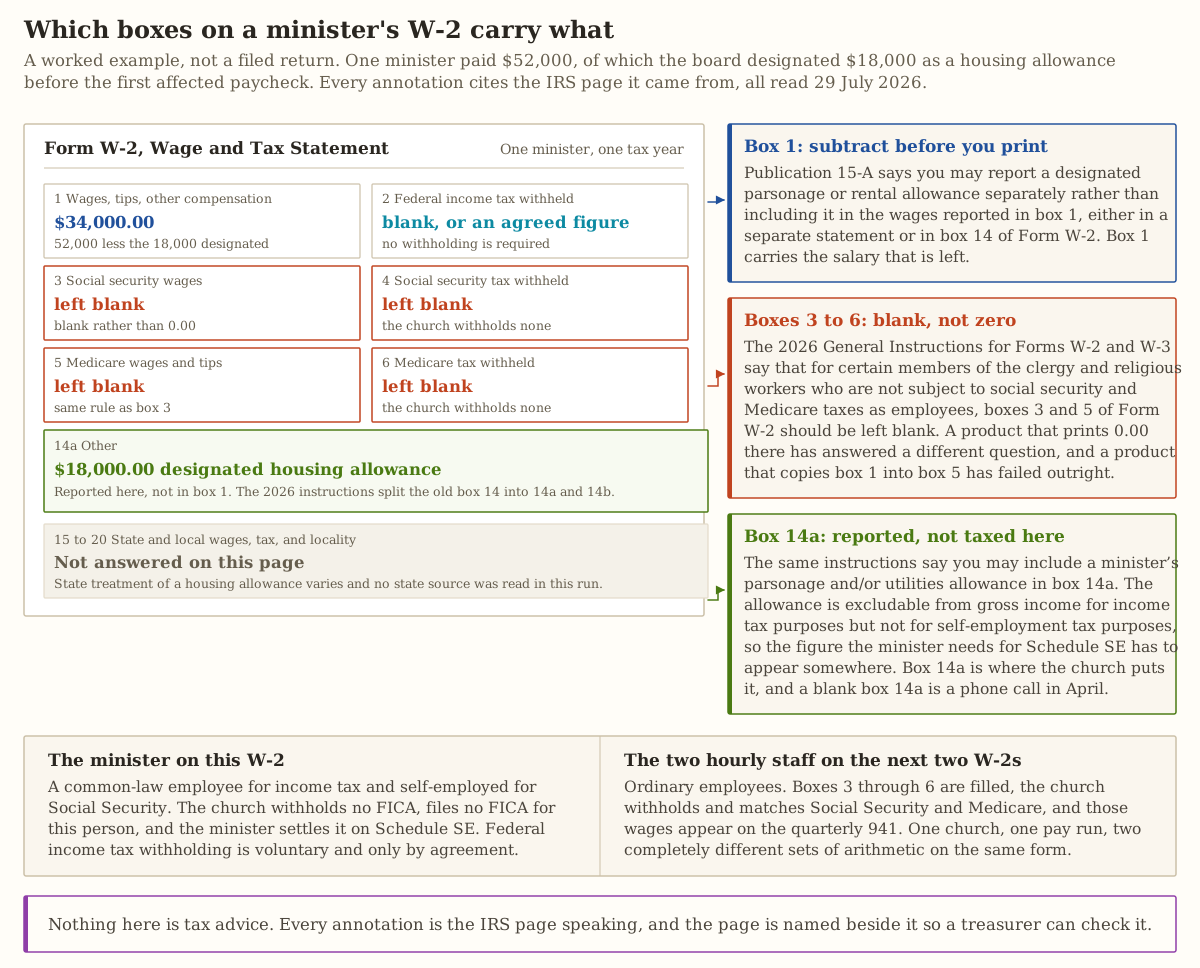
Box 1 carries $34,000. The designated allowance comes out before the box is filled. Publication 15-A’s wording is permissive rather than mandatory, and Publication 517 says a church or employing organization may report the rental allowance or the fair rental value of the parsonage, and utilities, in box 14. Both routes keep the allowance out of taxable wages.
Boxes 3 and 5 are blank, and blank is not zero. The 2026 General Instructions for Forms W-2 and W-3 state that “for certain members of the clergy and religious workers who are not subject to social security and Medicare taxes as employees, boxes 3 and 5 of Form W-2 should be left blank.” A product that prints 0.00 there has answered a question nobody asked. A product that copies box 1 into box 5 has failed the whole exercise.
Box 14a carries the $18,000. The same instructions say “you may include a minister’s parsonage and/or utilities allowance in box 14a.” Note the letter. Box 14 was split for the 2026 forms into box 14a for other items and box 14b for Treasury tipped occupation codes, so a template or a mail merge carrying last year’s box label needs looking at before January.
That box 14a figure is not decoration. The IRS answer on ministers’ compensation and housing allowance is that the allowance is “excludable from gross income for income tax purposes but not for self-employment tax purposes,” and it caps the exclusion at the lesser of the designated amount, actual housing costs, or the fair rental value of the home. The minister needs the designated figure to compute self-employment tax, and any excess allowance goes on line 1h of Form 1040 marked “Excess allowance.” A blank box 14a turns that into a phone call in April.
Box 2 is usually blank, and it does not have to be. Publication 15-A tells the employer that “you may agree with the minister to voluntarily withhold tax to cover the minister’s liability for self-employment tax and federal income tax.” That agreement is the single most useful thing a church can offer a minister who has been writing quarterly estimated payments, and it needs a payroll product that will withhold a flat agreed amount for one employee without deriving it from a W-4 table.
The designation is a board action with a date on it. The IRS requirement is that “the minister’s employing organization must officially designate the housing allowance as such before paying it to the minister,” and the exclusion cannot exceed reasonable compensation for the minister’s services. A designation written in March does not reach back to January. Put it in the minutes at the meeting where the budget is approved.
The four gates, and what a failure looks like
The published pages tell you what a vendor claims. A demo tells you what the software does. These are the four things to make somebody show you on a shared screen, in order, with one minister and one hourly employee in the same test company.
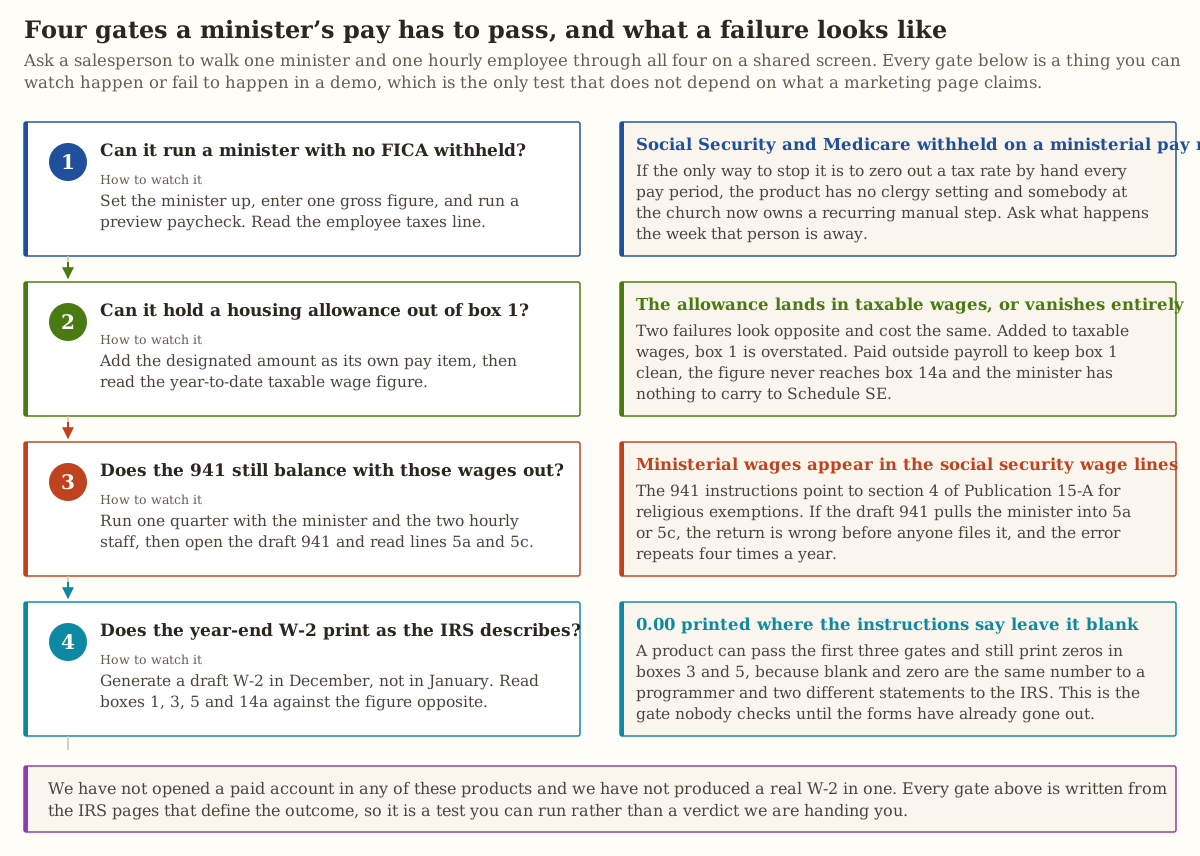
Gate two is the one that catches the clever workaround. A church that cannot get a housing allowance to sit outside box 1 sometimes pays it outside payroll entirely, by check, from the general fund. Box 1 comes out right and box 14a comes out empty, so the minister has nothing to carry to Schedule SE and the designated figure exists only in the minutes. Both failures are quiet, and both surface in April.
Gate four is the one nobody checks in time. Generate the draft W-2 in December, because a product can pass the first three gates and still print zeros where the instructions say blank. Blank and zero are the same number to a programmer and two different statements to the IRS.
What each product publishes, and what it will not
Every row below reflects what the vendor’s own pages served to our requests on 29 July 2026. Where a page refused, the row says so and carries no number and no capability claim, because a guess about a real company’s product is worse than a gap.
| Product | Published price | What its own pages say about ministers | Read on 29 July 2026 |
|---|---|---|---|
| Patriot Basic Payroll | $17 a month base plus $4 per employee a month | Nothing about clergy on the pricing page. Tax filing is not included on this plan | Price page served |
| Patriot Full Service Payroll | $37 a month base plus $5 per employee a month | Same. Federal, state and local filings and year-end submissions are included at no extra fee | Price page served |
| OnPay | $49 a month base plus $6 per worker a month | Lists religious organizations as an industry it serves. Its nonprofit payroll page states the clergy rule in its own words | Price page and nonprofit page served |
| Payroll Partners | No price published anywhere on the site | The most specific product claim of anyone here, quoted below | Churches page served |
| ADP RUN | No price on the product page or the four-package comparison. Both route to Get Pricing and a phone number | Nothing about clergy on either page. The offer on the page is 3 months free payroll | Both pages served, no price on either |
| Paychex | No price on the payroll page or the plan comparison. Both route to a quote request | Nothing about clergy on either page | Both pages served, no price on either |
| Gusto | Not read | Not read | gusto.com/product/pricing, gusto.com/pricing and support.gusto.com all returned HTTP 403 to our requests |
| Intuit QuickBooks Payroll | Not read | Not read | quickbooks.intuit.com/payroll/pricing and quickbooks.intuit.com/pricing timed out on our requests |
| MinistryWorks | Not read | Not read | ministryworks.com and www.ministryworks.com returned HTTP 403 to our requests |
| Clergy Financial Resources | Not read | Not read | clergyfinancial.com returned an unfollowed HTTP 307 redirect to our requests |
Four of the ten rows above would not serve a page to an automated request, and two of those four are the church-specialist products a reader searching this phrase is most likely to be sent to. That is a real gap in this page and it is stated rather than filled. Our standing rule on what happens when a vendor page refuses is in how we review.
Two of the largest names in the category publish no price at all. ADP’s package comparison names Essential Payroll, Enhanced Payroll, Complete Payroll & HR Plus, and HR Pro Payroll & HR, attaches a figure to none of them, and says “you don’t have to sign a contract, and services can be terminated at any time.” Paychex names Flex Select, Flex Pro, Flex Enterprise, HR Pro, and HR PEO, and says “a Paychex representative can help you determine a payroll plan that best fits your business and budget needs.” Both are legitimate ways to sell payroll and neither is a way to compare it. If a church goes down that road, get four numbers in one written document before signing: the monthly total for three employees, the per-payroll charge, the year-end W-2 charge, and the year-two renewal price.
What a three-person church payroll costs a year
Three plans in that table carry a published rate card, so three lines are all this chart can honestly hold. Every annual figure below is our arithmetic on the vendor’s published base and per-person rates, not a number printed by the vendor.
- Patriot Basic does not file your taxes
- Patriot Full Service filings included
- OnPay filings included
Derived, not read. Base and per-person rates were read off each vendor's own pricing page on 29 July 2026 and multiplied out: Patriot Basic is $17 plus $4 a head, Patriot Full Service is $37 plus $5 a head, OnPay is $49 plus $6 a head, and each monthly total is multiplied by twelve. Patriot's published promotional terms of 30 days free and 50 percent off for six months are not modelled here, because the terms do not state whether the free month precedes or overlaps the discount period. Gusto, QuickBooks Payroll, MinistryWorks and Clergy Financial published no figure to our requests on that date, and ADP, Paychex and Payroll Partners publish none at all, so none of them can be drawn.
See the numbers
| Vendor | 1 on payroll | 3 on payroll | 8 on payroll | 20 on payroll |
|---|---|---|---|---|
| Patriot Basic | $252 | $348 | $588 | $1,164 |
| Patriot Full Service | $504 | $624 | $924 | $1,644 |
| OnPay | $660 | $804 | $1,164 | $2,028 |
Take the ordinary case: one minister and two hourly staff. At three people the published rate cards work out at $29 a month with Patriot Basic, $52 with Patriot Full Service, and $67 with OnPay, which is $348, $624, and $804 a year. The arithmetic is $17 plus three times $4, $37 plus three times $5, and $49 plus three times $6, each multiplied by twelve.
One number in that chart is worth pausing on. Patriot Basic at 20 people and OnPay at 8 people both land on $1,164 a year, and they are not the same purchase. Patriot Basic does not file your taxes. At three people the gap between Patriot’s two plans is $276 a year, $624 less $348, and what that $276 buys is federal, state and local filings and the year-end submissions. A church that keeps the $276 has bought itself the job of filing 941s and depositing federal tax on time, and the penalty for one late deposit erases several years of the saving. For a church with three employees and a volunteer treasurer, the filing service is the product.
One figure verifies itself. At a single worker, OnPay’s published rates come to $55 a month, which is exactly what its own site footer claims when it says pricing starts at $55 per month. Two separately published numbers reconciling to the penny is more than most vendor pages manage.
Patriot’s pricing page also prints promotional rates of $8.50 and $18.50 on the two base fees with $2 and $2.50 per employee, under terms of 30 days free plus 50 percent off for six months. Those are exactly half the standing rates. We have not published a blended year-one total, because the published terms do not say whether the free month sits inside or before the discounted six, and inventing the sequence to reach a tidier number is the move this library exists to avoid.
What three of them actually say about a minister’s pay
Price is the easy half of this purchase. The hard half is whether the product can produce the form.
Payroll Partners makes the most specific claim of anyone whose pages we could read. Its churches page lists “minister’s housing allowance & self-employment tax” as something the payroll engine handles, and states that “ordained ministers receive a W-2 but are responsible for self-employment tax, and our solutions are built to handle that configuration correctly.” The same page names fund and general ledger cost allocation and labor expense reporting by fund, which is the other half of a church’s problem and the reason a general product forces a manual journal entry every month. Its home page describes church payroll and timekeeping that “handles clergy housing allowances, multi-campus staff, volunteers, and fund-based pay.” Not one page on the site carries a price.
OnPay is the only product here that both publishes a rate card and publishes the clergy rule. Its nonprofit payroll page states that clergy “do not have FICA taxes withheld from their pay. This includes Social Security and Medicare taxes,” and that “a licensed minister may be able to exclude the fair rental value of a home provided as part of their compensation or a housing allowance.” Read that page beside Publication 15-A and one difference shows up. OnPay’s page says ministers are responsible for self-employment tax “because they don’t have income tax withheld by their tax-exempt church.” Publication 15-A says the church may agree with the minister to voluntarily withhold tax covering both self-employment tax and federal income tax. A church reading only the vendor page would not learn that the option exists, and it is the option most ministers would take if anyone offered it.
Patriot publishes the cheapest rate card in the set and says nothing about clergy on the pages we read. That is not a mark against the product and it is not a pass either. It means the answer to gate one has to come from a trial or a support ticket, not from a page.
The product a church already owns matters here too. Several accounting packages priced in what church software costs carry a payroll module, and the module is often the reason a church stays on a ledger it has outgrown. Price the two separately and then together, the same way the ledger and the donor system get shopped together and sold separately.
What we did not test
No trial or paid account was opened in any product named on this page, and no real W-2 was produced in any of them. Nobody here has run a minister’s pay through any of these products and watched what came out the other end.
That means the four gates above are tests, not results. They are written from the IRS pages that define the correct outcome, which is what makes them usable by a church sitting in a demo. What this page cannot tell you is which product passes, because passing is a thing you observe and not a thing you infer from a feature list.
When the trial accounts exist, this page gets a pass-or-fail column with a date on it. Until then the gap stays visible.
Two further things could not be obtained honestly. State unemployment treatment and workers compensation requirements vary state by state, no state statute was read in this run, and that is why the state boxes on the annotated form are greyed out. And no vendor was asked to confirm a capability by email, so nothing here reports a support answer.
Does a church have to withhold anything from a minister?
Not FICA on ministerial services, and not federal income tax unless the church and the minister agree to it. The IRS treats ministerial earnings as outside the ordinary withholding rules, and Publication 15-A offers voluntary withholding by agreement as the alternative to the minister making quarterly estimated payments. The two hourly staff on the same payroll are withheld from in the ordinary way.
The exemption a minister can apply for is a separate matter and it belongs to the minister. Form 4361 is filed “to apply for an exemption from self-employment tax if you have ministerial earnings,” by “an ordained, commissioned, or licensed minister of a church,” a member of a religious order who has not taken a vow of poverty, or a Christian Science practitioner. It is due by the due date of the return for the second tax year with at least $400 of net self-employment earnings. An approved 4361 is not a payroll setting and it does not change any box described above.
The 941, the 940, and the form churches forget
The 941 is where a bad setup repeats itself. Ministerial wages do not belong in the social security or Medicare wage lines. Run a full quarter in a trial with the minister and both hourly staff, open the draft return, and read lines 5a and 5c. If the minister’s pay is in there, the engine is deriving 941 wages from gross pay and the error arrives every quarter.
The 940 is the one a church may not owe at all. The Instructions for Form 940 state that “religious, educational, scientific, charitable, and other organizations described in section 501(c)(3) and exempt from tax under section 501(a) generally aren’t subject to FUTA tax,” with the exception that “a section 501(c)(3) organization is subject to FUTA tax when paying wages to employees on behalf of a non-section 501(c)(3) organization.” A payroll product whose setup wizard never asked about exempt status may file a 940 for a church that owes nothing on it. Ask where that switch lives before the first quarter closes.
Form 8274 is the form churches never hear about. Publication 15-A section 4 includes, among the conditions it lists, that “the organization is a church or church-controlled organization opposed for religious reasons to the payment of social security and Medicare taxes and has filed Form 8274 to elect exemption.” That election is about lay employees, not ministers, and it is a different decision with different consequences from the ministerial rules on this page. The IRS page describing the form returned a 404 to our requests on 29 July 2026, so this page reports only what Publication 15-A says about it and points anyone considering it at a CPA.
The nursery worker, the custodian, and the office administrator are ordinary employees unless that election has been made and accepted. The minister rules do not reach them, and treating a scheduled, supervised, weekly worker as a contractor to avoid the payroll is the most expensive habit in church bookkeeping. The classification tests are worked through in the accounting guide.
Take the field map into the demo
The minister W-2 field-mapping reference is a CSV holding all of the above in a form you can put in front of a salesperson: every box on the form, what a minister’s entry is, what the same box holds for an hourly employee, the worked example figure, the exact question to ask the vendor, and the IRS URL the row came from. It also carries the 941, 940, 8274, 4361 and Schedule SE rows, the three published rate cards with the arithmetic shown, and a block naming every page that refused us.
Print it, open the demo, and write the answer beside each row. A vendor who cannot answer rows 3 and 5 in a live screen share has answered the whole sheet.
Payroll records are the most sensitive file a church holds: Social Security numbers, bank details, and pay for every person on staff. The storage and access obligations that come with holding them are in protecting member data, and the fee arithmetic on the money coming in is in what giving platforms actually cost.
Do this before the next pay run
Pull the most recent minister paycheck and read three numbers off it: Social Security withheld, Medicare withheld, and the housing allowance line. If either of the first two is anything other than zero, the product is running your minister as an ordinary employee and it has been doing so since setup. Fix it before the quarter closes, because a 941 already filed is a correction and not an edit.
Then make the decision this page exists to force. If your church has one minister and two hourly staff and no volunteer who will file a 941 on time, buy the cheapest published rate card that includes tax filing and test it against the four gates in the trial: that is Patriot Full Service at $37 a month plus $5 a head, $52 a month and $624 a year for three people at the rates published on 29 July 2026. If gate one or gate two fails in that trial, move to OnPay at $49 plus $6 a head, $67 a month and $804 a year for three, which is the only product here that both publishes a price and publishes the clergy rule. If both fail, ask Payroll Partners for a written monthly total for three employees, because it makes the most specific claim about a minister’s W-2 of any vendor we could read, and a price you have to ask for is still a price.
Do not buy on a feature list. Buy on a draft W-2 with your own minister’s numbers in it, generated in December, with boxes 3 and 5 empty.
Sources
Every page below was fetched on 29 July 2026, and every price, rate, and quotation in this guide came off the page linked here on that date. Nothing in this guide is tax advice for your church.
IRS on minister status, withholding, and the form
- Common-law employee status, Social Security coverage under the self-employment tax system, the designation requirement, and the reasonable-compensation limit: Topic no. 417, Earnings for clergy. Checked 29 July 2026.
- Boxes 3 and 5 left blank for clergy, box 14a for a parsonage or utilities allowance, the 14a and 14b split for 2026, and the 1 February 2027 filing date: General Instructions for Forms W-2 and W-3 (2026). Checked 29 July 2026.
- Religious exemptions and the special rules for ministers, including reporting the allowance separately from box 1, voluntary withholding by agreement, and the Form 8274 election: Publication 15-A (2026), section 4. Checked 29 July 2026.
- Reporting the rental allowance or the fair rental value of the parsonage and utilities in box 14: Publication 517. Checked 29 July 2026.
- The allowance excludable for income tax but not for self-employment tax, the three-way cap, and excess allowance on line 1h: Ministers’ compensation and housing allowance. Checked 29 July 2026.
- Who files for exemption from self-employment tax and by when: About Form 4361. Checked 29 July 2026.
- The pointer to section 4 of Publication 15-A for religious exemptions: Instructions for Form 941 (Rev. March 2026). Checked 29 July 2026.
- The FUTA exemption for section 501(c)(3) organizations and the exception to it: Instructions for Form 940. Checked 29 July 2026.
- irs.gov/forms-pubs/about-form-8274 returned HTTP 404 to our requests on 29 July 2026, so this guide reports Form 8274 only as Publication 15-A describes it.
Vendor pages that served a price
- Basic Payroll and Full Service Payroll base and per-employee rates, the promotional rates, and what each plan includes: patriotsoftware.com/payroll/pricing. Checked 29 July 2026.
- Base and per-worker rate, inclusions, and the industries served: onpay.com/pricing. Checked 29 July 2026.
Vendor pages that served no price
- Four package names, the three-months-free offer, and the no-contract statement: ADP RUN payroll packages and the RUN product page. Both checked 29 July 2026, neither carrying a figure.
- Plan names and the routing to a quote request: Paychex payroll and compare payroll solutions. Both checked 29 July 2026, neither carrying a figure.
- Clergy housing allowance and self-employment tax handling, fund and general ledger allocation, and the ministers-receive-a-W-2 statement: payrollpartners.com/industries/churches and payrollpartners.com. Both checked 29 July 2026, neither carrying a figure.
Vendor pages on clergy handling
- Clergy FICA treatment, the housing exclusion, and the estimated-tax statement compared above with Publication 15-A: OnPay nonprofit payroll. Checked 29 July 2026.
What refused
- Gusto: gusto.com/product/pricing, gusto.com/pricing, gusto.com/product/pricing/simple and support.gusto.com all returned HTTP 403 on 29 July 2026. No Gusto figure or capability claim appears in this guide.
- Intuit: quickbooks.intuit.com/payroll/pricing and quickbooks.intuit.com/pricing timed out on 29 July 2026. No QuickBooks figure appears in this guide.
- MinistryWorks: ministryworks.com and www.ministryworks.com returned HTTP 403 on 29 July 2026. No MinistryWorks figure or capability claim appears in this guide.
- Clergy Financial Resources: clergyfinancial.com returned an unfollowed HTTP 307 redirect on 29 July 2026. No Clergy Financial figure or capability claim appears in this guide.
- Brotherhood Mutual: brotherhoodmutual.com returned HTTP 403 on 29 July 2026.