
What church software costs at 80, 200, 500, and 1,200 people
A full annual cost model built from prices read off fifteen vendor pricing pages on 29 July 2026, with the hidden costs, a calculator, and the price book as a CSV.

A church of 1,200 people running a normal stack pays about $6,528 a year for software. That same church pays about $38,400 a year to card networks on its online giving. The first number goes in the budget under a line called software. The second one is never in the budget at all, because it comes out of the offering before the offering is counted.
Every figure on this page was read off a vendor’s own pricing page on 29 July 2026 and is linked at the claim. Where a vendor publishes no price, this page says so instead of guessing.
The short answer, at four sizes
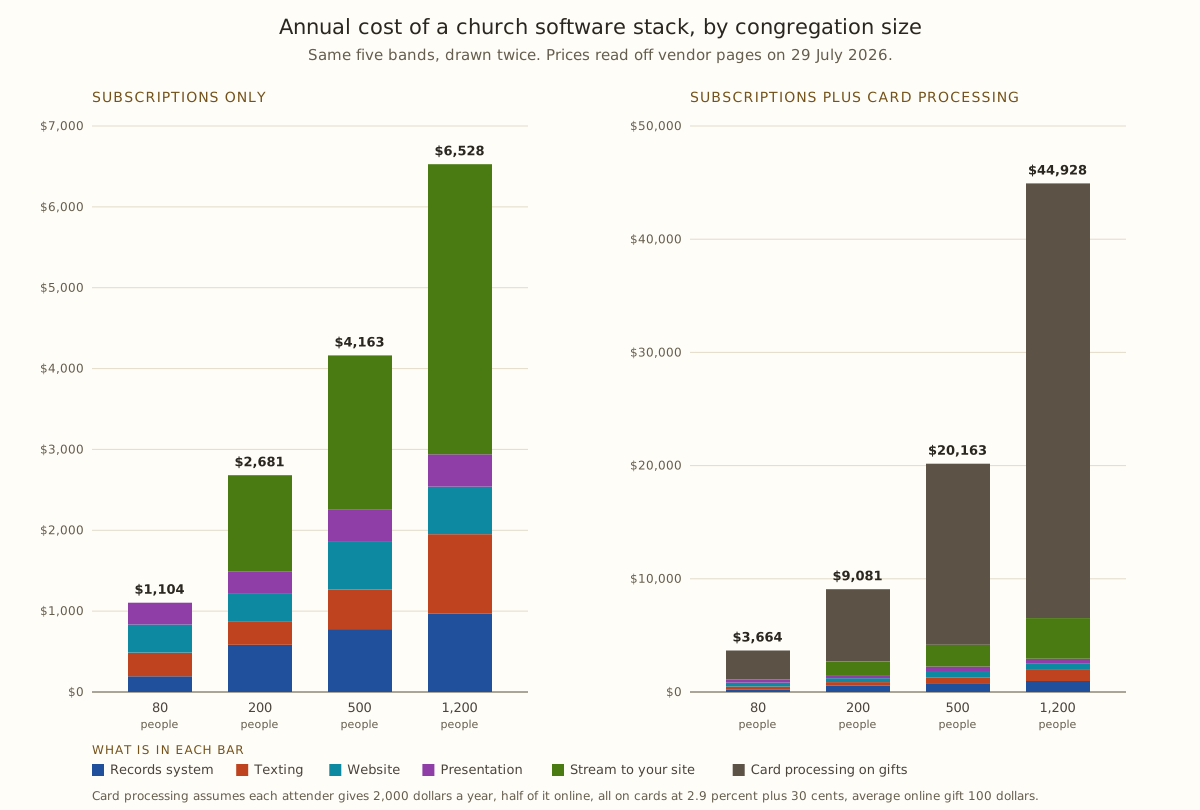
Church software costs roughly $1,100 a year at 80 people, $2,700 at 200, $4,200 at 500, and $6,500 at 1,200. Card processing on online giving adds two to six times that. Total cost of ownership lands near $40 per attender per year at every size, and three quarters of it is payment processing rather than software.
| Congregation | Subscriptions | Card processing | Total | Per attender |
|---|---|---|---|---|
| 80 | $1,104 | $2,560 | $3,664 | $45.80 |
| 200 | $2,681 | $6,400 | $9,081 | $45.41 |
| 500 | $4,163 | $16,000 | $20,163 | $40.33 |
| 1,200 | $6,528 | $38,400 | $44,928 | $37.44 |
The subscription column is the sum of a records system, a texting service, a website, presentation software, and a stream to your own site, each priced at the tier that size of church actually needs. The processing column applies the standard 2.9 percent plus 30 cents card rate to half of a congregation’s giving. Every input is stated below and every one of them is yours to change.
Why nobody publishes this number
Search for what church software costs and you get vendor pricing pages one at a time, and every one of them meters on something different. That is not an accident of presentation. It is the reason a comparison is hard to build and easy to avoid.
Read down this column and you are reading eight incompatible units of account.
| Vendor | Product | The bill is metered on |
|---|---|---|
| ChurchTrac | Everything | Names in the database |
| Breeze | Everything | Nothing. One flat rate |
| Servant Keeper | Everything | Estimated users, 4 or 8 |
| Planning Center | Services | People who can log in |
| Planning Center | Check-Ins | People who check in on your busiest day |
| Planning Center | Groups | Members inside an active group |
| Planning Center | Giving | Total donations a month |
| Planning Center | Calendar | Rooms you manage |
| Planning Center | Registrations | Attendees at your largest event |
| Clearstream | Texting | Outgoing message credits |
| Text In Church | Texting | Outgoing message credits |
| Resi | Streaming | Bandwidth and destinations |
| Tithely, Subsplash | Giving | A share of every gift |
A church has one number in its head, which is how many people were in the room on Sunday. Not one vendor in that table bills on it. The gap between the number you know and the number you are charged for is where a budget goes wrong, and it goes wrong in one direction.
The clearest case is the first row. A records system that meters on names counts everybody who has ever filled in a card, not everybody who came this week. A congregation of 200 on a Sunday routinely carries 300 or 400 names, because members who moved away, adult children, and eight years of guest cards are all still rows in the table. Price the 250-name tier because 200 people come on Sunday and the invoice arrives at the 500-name tier. Export your own file and count the rows before you shop.
Records systems: one line scales, two do not
This is the only category where the vendor you pick changes the answer by a factor of eight.
- ChurchTrac paid yearly, priced on names
- Planning Center six products, six meters
Prices read off each vendor's own pricing page on 29 July 2026. ChurchTrac is priced on names rather than attendance, taken here as one and a half times the Sunday count, so the four columns sit on the 125, 500, 1,000 and unlimited name tiers. Planning Center is the sum of six products at the tiers in the table further down. The two flat-rate systems in this category, Breeze at $864 a year and Servant Keeper core at $879.89, would draw as horizontal lines between the two plotted here.
See the numbers
| Vendor | 80 people | 200 people | 500 people | 1,200 people |
|---|---|---|---|---|
| ChurchTrac | $194 | $583 | $778 | $972 |
| Planning Center | $900 | $2,100 | $4,524 | $7,728 |
Two things in that chart are worth more than the rest of this page.
The first is that the gap between the two lines is $706 a year at 80 people and $6,756 a year at 1,200. That is a full-time nursery worker at the top end, decided by a purchasing choice most churches make in an afternoon.
The second is what the two flat-rate systems do to the same picture. Breeze charges $864 a year at every size and Servant Keeper core charges $879.89. At 120 names in the database the flat rate is four and a half times the metered rate, so a small church that buys it is overpaying by about $670 a year. At 1,800 names the flat rate is the cheapest thing in the category, $108 a year under ChurchTrac’s unlimited tier and $6,864 under Planning Center. The same product is the wrong answer and then the right answer, and nothing about it changed.
ChurchTrac
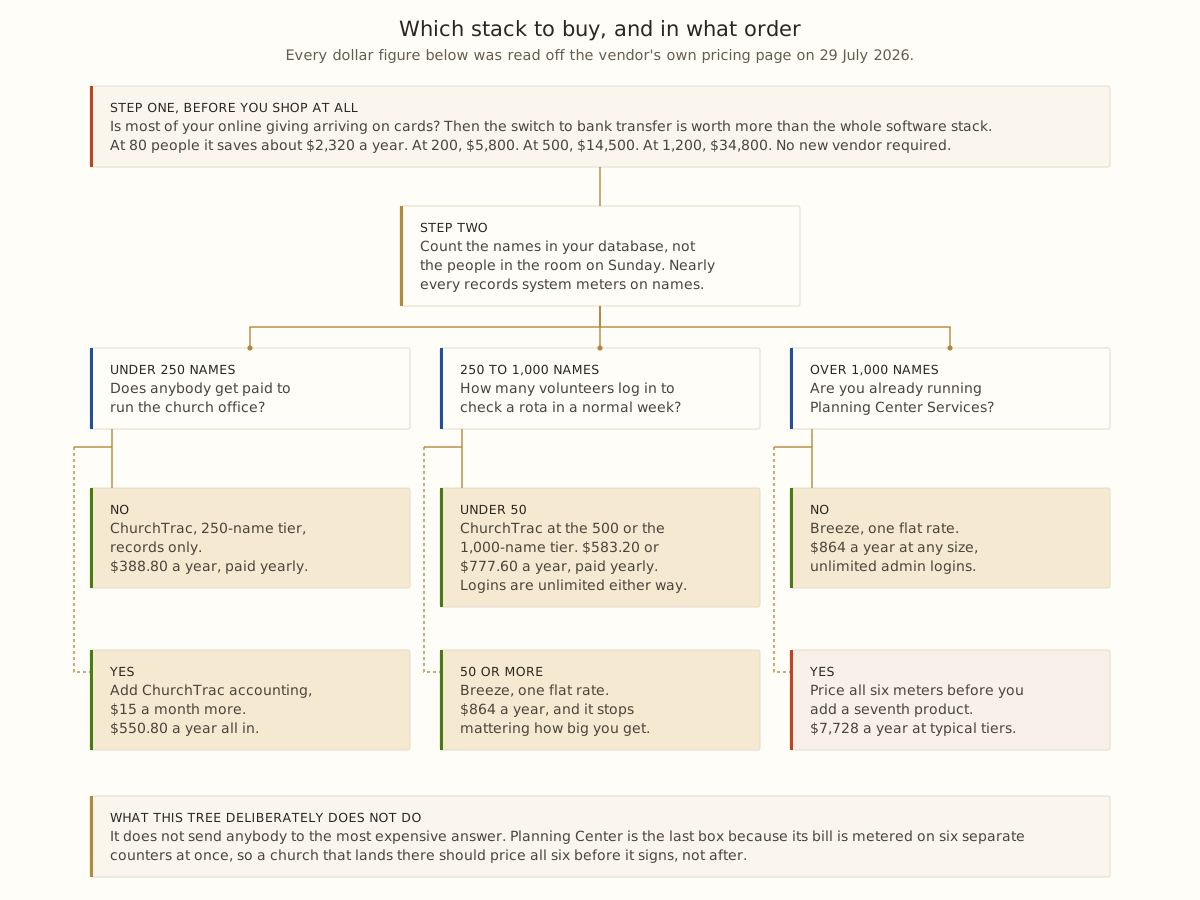
$9 a month at 75 names, $18 at 125, $36 at 250, $54 at 500, $72 at 1,000, and $90 for unlimited names. Paying yearly multiplies the monthly rate by 10.8 rather than 12, which the ChurchTrac pricing page calculates on the page itself, so the 250-name tier is $388.80 a year rather than $432. Fund accounting is a $15 a month add-on and texting is $7 a month for 250 credits.
What it is bad at: the name meter is the whole risk. A church that grows its database past a tier boundary between two Sundays sees the bill step by 50 to 100 percent, and no amount of tidying removes a name that a family still expects to be in the directory. Data import is free, which matters more than it sounds and is covered further down.
Who should skip it: nobody buying on price. If the price is not the point, the ceiling on customization is.
Breeze
$72 a month, and that is the entire price list. The Breeze pricing page states no setup fee, no contract, and no tiers or limits based on growth, with unlimited admin users and unlimited people. Giving is included. Texting gives 250 messages a month and then charges $10 per 500, which is 2 cents a message and the second cheapest overage in this whole page.
What it is bad at: it costs $864 a year whether you have 80 people or 8,000, so the smaller you are the worse the deal. Worship planning is a separate $29 a month, which pushes a church that needs it to $1,212 a year.
Who should skip it: a congregation under about 250 names. At that size the flat rate is charging you for headroom you will not use for years.
Servant Keeper
$79.99 a month, or $73.32 a month paid annually, which the Servant Keeper pricing page prints as $879.89 a year. Families and members are unlimited. The meter is estimated users, 4 on core and 8 on complete. Complete runs $146.66 a month paid annually, $1,759.89 a year, and folds in a website, an app, 1,000 texts a month, a 50 GB media library, and 25 hours a month of 720p streaming.
What it is bad at: check-in is a $199 option on the core plan rather than a feature, and 4 users is thin the moment a children’s director, a worship leader, and a treasurer all want their own login.
Who should skip it: a church that would use fewer than four of the things on the complete plan. At that point you are buying a bundle to get one item in it, which is the most expensive way to buy anything.
Planning Center
The most widely used and by far the hardest to price, because it is not one product. Planning Center’s pricing page gives every product the same ladder, $0, $15, $32, $69, $115, $179, $239 a month, and then meters each one on a different counter. People is free and unlimited. Publishing Essential is free.
A church that runs the six products most churches actually run pays this:
| Product | 80 people | 200 people | 500 people | 1,200 people |
|---|---|---|---|---|
| Services | $15 (20 logins) | $32 (50) | $69 (150) | $115 (400) |
| Check-Ins | $15 (30 a day) | $32 (75) | $69 (200) | $115 (500) |
| Groups | $15 (75 members) | $32 (200) | $69 (500) | $115 (1,000) |
| Giving | $15 (75 gifts) | $32 (200) | $69 (500) | $115 (1,000) |
| Calendar | free (1 room) | $15 (5 rooms) | $32 (15) | $69 (30) |
| Registrations | $15 (20 attendees) | $32 (50) | $69 (150) | $115 (400) |
| A month | $75 | $175 | $377 | $644 |
| A year | $900 | $2,100 | $4,524 | $7,728 |
What it is bad at: the meters move independently, so one big event in June can push Registrations up two tiers on its own and nothing about the church changed. The free tiers are advertised prominently and are almost unusably small: 5 team members, 10 daily check-ins, 15 group members, 10 monthly donations, 1 room. Every one of those is exceeded by a church of 60 people.
Who should skip it: a church buying only a membership database. People is free and unlimited, so take that and stop. The bill starts when you add the second product, and it never stops adding.
Nothing on that page is dishonest. Every number is published and every meter is named. It is simply not comparable to a flat rate without doing this arithmetic, and no vendor has any reason to do it for you. If you want the decision framework rather than the prices, it is in choosing church management software, and the exact point each free tier stops is in free church management software.
The four categories that barely move with size
Records systems scale. Almost nothing else does.
- Texting Clearstream
- Website The Church Co
- Presentation Proclaim
- Streaming Resi
Prices read off each vendor's own pricing page on 29 July 2026. Streaming reads $0 at 80 people because a church that size can send a phone or an OBS feed straight to a social platform for nothing. The records system sits in the chart above rather than here.
See the numbers
| Vendor | 80 people | 200 people | 500 people | 1,200 people |
|---|---|---|---|---|
| Texting | $292 | $292 | $490 | $980 |
| Website | $348 | $348 | $588 | $588 |
| Presentation | $270 | $270 | $400 | $400 |
| Streaming | $0 | $1,188 | $1,908 | $3,588 |
Texting is metered on outgoing credits, so it scales with how often you send rather than how many people you have. Clearstream runs $29 a month for 1,250 credits, $49 for 2,500, $99 for 6,000 and $199 for 12,000, with 16 percent off for paying annually, no contract and no setup fee, and incoming texts and all email free. Text In Church is $369 a year for 500 credits a month, $668 for 1,500 and $967 for 2,500, with unlimited users and contacts and 3 cents a message over the limit.
The trap is segmenting. Six sends a month to a 720-person opted-in list is 4,320 credits and fits inside Clearstream’s $99 tier. Move to twelve sends a month, which is roughly three a week, and you are at 8,640 credits, which is the $199 tier, and the annual bill goes from $979.84 to $1,979.84 for the same list. The full ten-vendor comparison with per-message pricing is in church texting services.
Websites do not scale with congregation size at all. The Church Co is $29 a month paid yearly on Basic, $49 on Premium, and $199 on Ultimate, with a free simple setup on any yearly plan and paid setup packages at $299, $799 and $999. Nucleus is $99 a month or $1,188 a year, and paying yearly saves nothing. What moves the price is how many pages somebody else builds for you, not how many people read them. More on the trade at the small end in small church website options.
Presentation software also ignores size. Proclaim is $269.99 a year on On Air, $399.99 on Pro Media, and $999.99 on Partner Media, and the monthly equivalents are $26.99, $39.99 and $99.99, so paying annually saves about 17 percent. EasyWorship is $17.50 a month billed yearly, $210, with a higher tier at $27.50, $330.
ProPresenter is the exception worth naming. No price appears anywhere on renewedvision.com/propresenter or on the front page of the accounts store as fetched on 29 July 2026. The category leader publishes no rate, so this page carries none for it. Ask for a written quote and compare it against the numbers above rather than against a memory of what it used to cost. The rest of that category is in presentation and lyrics software.
Streaming is the only category with a genuine zero. A church sending a feed to a social platform pays nothing for the software. The bill starts the moment you want the stream on your own site and want it to survive a bad connection. Resi prints $99 a month and $1,188 a year for Social Only, $159 and $1,908 for Starter Lite, which is the first tier that streams to your own website with 200 GB of monthly bandwidth, and $299 and $3,588 for Pro. The page’s own toggle advertises 20 percent off for paying annually, and the three annual figures are exactly twelve times the rates printed beside them, so ask what the month-to-month rate is before you assume the discount is already in the number you are looking at.
So four of five subscription categories are flat or near flat, and a church that budgets by growth is budgeting the wrong variable. The variable that grows is the offering, and that is where the money actually goes.
The cost that dwarfs the software
Faith Communities Today’s 2020 national survey put the median congregation’s annual income at $120,000, with 85 percent of it from individual donations and an average of $2,000 per person a year, against a median weekly attendance of 65 (Faith Communities Today 2020 summary report). That $2,000 is the only per-person giving figure in this piece and it carries a caveat the report supplies itself: per capita giving falls as a congregation grows, so the largest column below runs high. Replace it with your own total.
Take the $2,000 figure, assume half of it arrives online, and assume an average online gift of $100. Then apply the standard card rate published by Tithely and used as the benchmark inside Subsplash’s own savings calculator, 2.9 percent plus 30 cents.
| Congregation | Giving a year | Online half | Gifts | Card fees at 2.9% + 30c | At 1% + 30c | At 0% + 30c |
|---|---|---|---|---|---|---|
| 80 | $160,000 | $80,000 | 800 | $2,560 | $1,040 | $240 |
| 200 | $400,000 | $200,000 | 2,000 | $6,400 | $2,600 | $600 |
| 500 | $1,000,000 | $500,000 | 5,000 | $16,000 | $6,500 | $1,500 |
| 1,200 | $2,400,000 | $1,200,000 | 12,000 | $38,400 | $15,600 | $3,600 |
Those last three columns are all real published rates. Tithely charges 2.9 percent plus 30 cents on cards and 1 percent plus 30 cents on bank transfer. Subsplash charges 2.3 percent plus 30 cents on cards and 1 percent on bank transfer with no per-transaction fee, and says the card rate can fall as low as 1.9 percent under a program it does not publish qualifying rules for. Planning Center charges 2.15 percent plus 30 cents on cards and 0 percent plus 30 cents on bank transfer.
Read the 1,200-person row again. Moving that congregation’s online giving from cards to bank transfer on Planning Center’s schedule takes payment processing from $38,400 to $3,600. The saving is $34,800 a year, which is five and a half times the entire annual software stack for a church that size. At 200 people the saving is $5,800, which is more than double the software stack. At 80 people it is $2,320, which is twice the stack.
There is no vendor to switch to and no contract to sign. The change is one sentence on the giving page and a default on the recurring gift form, and the fee schedule for every platform in this piece already contains the cheaper number. The full fee table for the giving cluster, including the receipting rules a statement has to satisfy, is in what giving platforms actually cost your church.
Why is card processing not in the software budget?
Because it is deducted from each gift before the deposit lands, so it never appears as an invoice anybody has to approve. A church can spend a decade arguing about a $72 a month subscription while paying six times that in processing on the same platform, and both facts are on the same account page.
The hidden costs nobody quotes
Five costs sit outside every published price and all five are real.
Per-message overage. Every texting plan has a ceiling and every one charges differently past it. Clearstream sells extra credits at $10 per 125, which is 8 cents a message. Text In Church charges 3 cents. ChurchTrac charges $7 per 250, 2.8 cents. Breeze charges $10 per 500, 2 cents. That is a four-fold spread, and the vendor with the lowest headline price does not have the lowest overage. Count your sends for one month before you pick a tier.
Setup and onboarding. Servant Keeper prices check-in as a $199 option. Text In Church sells Concierge Account Setup starting at $249. The Church Co charges $299, $799 or $999 for anything past its free nine-page build. ChurchTrac states free data import. None of these appear in a monthly price and all of them appear in year one.
The tier cliff. This is the one that ruins a budget. ChurchTrac steps from $36 to $54 a month between 250 and 500 names, a 50 percent increase for one name. Planning Center steps from $69 to $115 between 200 and 500 daily check-ins, a 67 percent increase, and the counter that triggers it is the busiest single day of the year rather than a normal Sunday. Find out where your nearest cliff sits and how far you are from it, in every product, before you sign anything.
Migration labor. The number no vendor prints. Independent Sector and the Do Good Institute at the University of Maryland put the value of a volunteer hour at $36.14 for 2025, announced on 21 April 2026 (Independent Sector, value of volunteer time). A move between records systems takes an export, a cleanup pass on duplicate households, a field mapping, a test import, a real import, and retraining whoever runs the office. Sixteen hours of that is $578. Forty hours is $1,446. Sixty hours is $2,168. Compare that against the $670 a year you were going to save by switching and the arithmetic often says stay.
Annual billing. Paying yearly saves 10 percent at ChurchTrac, 8 percent at Servant Keeper, 16 percent at Clearstream, 17 percent at Text In Church, 17 percent at Proclaim, and an advertised 20 percent at Resi. It saves nothing at Nucleus. The saving is real and so is the lock: you have paid for twelve months of a product you have used for zero. Take the annual discount on the tool you have run for a year, and pay monthly for anything you are still testing.
Work out your own number
The four columns above are worked examples. Replace them with your own counts. Everything in this panel is arithmetic on the published rates linked in this page, done in the browser, and nothing is sent anywhere.
| Records system, cheapest of the three that publish a rate | ChurchTrac, 500-name tier, $583 |
|---|---|
| Texting | Clearstream, 1,250 credits, $292 |
| Everything you ticked above | $2,526 |
| Subscriptions a year | $3,401 |
| Card processing at 2.9% + 30c | $6,400 |
| The same giving by bank transfer at 0% + 30c | $600 |
| What the bank transfer switch saves you a year | $5,800 |
| Total now | $9,801 |
| Total with giving moved to bank transfer | $4,001 |
| Cost per attender per year, today | $49.01 |
Planning Center is not in the records line because its bill needs six separate counts rather than one. Use the table further up this page for that. The panel opens on the 200-person column with the streaming tier that reaches your own website, which is why it starts $720 above the table above. Figures round to the nearest dollar.
Which stack to buy
What to do in the next two weeks
Four things, in this order, and the first one is worth more than the other three combined.
Pull last year’s online giving and split it by card and bank transfer. Multiply the card volume by 2.9 percent, add 30 cents per gift, and write the dollar figure on one line. That is what your church paid for the convenience of a card button. Take it to the next finance or elders meeting as a dollar amount, never as a percentage, because a percentage does not get argued about and $6,400 does.
Rewrite the giving page to name the saving in dollars. Not “consider using ACH”. Something a person can act on: giving by bank transfer instead of card sends about $29 more of every $1,000 to the church. Then make bank transfer the first option on the form and the default on recurring gifts, because a recurring donor sets it once and never revisits it.
Export your database and count the rows. Then find where the next tier boundary sits on every product you pay for, and how many rows away it is. If you are within 10 percent of a cliff, you have a price rise coming that has nothing to do with a decision anybody made.
Only then decide whether to switch vendors. Price the switch honestly: the new subscription, the setup fee, and the migration hours at $36.14. If the annual saving is under $700 and the migration is over twenty hours, stay where you are and spend the effort on the giving page instead. Before you commit either way, ask what the platform lets you take with you when you leave, and get the answer in writing. The export test and the rest of that discipline is in protecting the data a church holds about its members.
If the accounting side is what triggered all of this, the fund tracking question is downstream and is covered in church accounting software. Current options by category sit in the church management directory, and how those rows are built and priced is written out in how we review software.
Take the numbers with you
Two files, both plain CSV, both openable in any spreadsheet.
The price book, 29 July 2026 holds every plan read for this page as one row each: category, vendor, product, plan name, list price, billing period, annual equivalent, what the plan is metered on, the tier limit, a note, the source URL, and the date it was checked. Fifteen vendors, 120 rows, including the row that says ProPresenter publishes no price.
The cost model, 29 July 2026 holds the four worked columns as 31 numbered lines, with the input rows separated from the calculated rows so you can drop in your own counts and watch the totals move. Every ratio used as an assumption is a labeled input line rather than a hidden constant.
Sources
Every price above was read off the page below on the date given. A vendor changes its rates on its own schedule, so check the page before you budget.
- ChurchTrac pricing. Name tiers at $9, $18, $36, $54, $72 and $90 a month, yearly multiplier 10.8, accounting $15 a month, messaging $7 a month for 250 credits. Checked 29 July 2026.
- Breeze ChMS pricing. $72 a month flat, no setup fee, no contract, no tiers, giving included, 250 texts a month then $10 per 500, Worship Tools $29 a month. Checked 29 July 2026.
- Planning Center pricing. Per-product ladder at $0, $15, $32, $69, $115, $179 and $239 a month, with the meter named for each product, plus card at 2.15 percent and 30 cents and ACH at 0 percent and 30 cents. Checked 29 July 2026.
- Servant Keeper pricing. Core $79.99 a month or $879.89 a year, complete $159.99 a month or $1,759.89 a year, check-in $199 optional on core. Checked 29 July 2026.
- Aplos pricing. Lite $79 a month, Core $129, Advanced from $229 for organizations above $250,000 in annual revenue. Checked 29 July 2026.
- Clearstream pricing. Eleven credit tiers, from free at 100 credits through $499 for 35,000 and on to $5,400 for 500,000, 16 percent off annually with no annual figure printed, extra credits $10 per 125. Checked 29 July 2026.
- Text In Church pricing. Basic $369, Pro $668 and Premium $967 a year, 3 cents a message over the limit, Concierge setup from $249. Checked 29 July 2026.
- The Church Co pricing. Basic $29, Premium $49 and Ultimate $199 a month paid yearly, setup packages free, $299, $799 and $999. Checked 29 July 2026.
- Nucleus pricing. $99 a month or $1,188 a year, no annual discount. Checked 29 July 2026.
- Resi pricing. Social Only $1,188, Starter Lite $1,908 and Pro $3,588 a year, against printed monthly rates of $99, $159 and $299 and a toggle advertising 20 percent off for annual billing. Checked 29 July 2026.
- Proclaim pricing. On Air $269.99, Pro Media $399.99 and Partner Media $999.99 a year, against monthly rates of $26.99, $39.99 and $99.99, with the page’s own “save up to 17% with annual billing” line. Checked 29 July 2026.
- EasyWorship pricing. $17.50 a month billed yearly at $210, higher tier $27.50 and $330. Checked 29 July 2026.
- ProPresenter. No price on the product page or on the front page of the accounts store. Attempted 29 July 2026.
- Tithely pricing. Card 2.9 percent plus 30 cents, American Express 3.5 percent plus 30 cents, ACH 1 percent plus 30 cents, Simply Everything bundle $119 a month. Checked 29 July 2026.
- Subsplash pricing. Giving at $0 a month, card 2.3 percent plus 30 cents, ACH 1 percent, GrowCurve stated as low as 1.9 percent and 0.5 percent, and a savings calculator that benchmarks competitors at 2.9 percent plus 30 cents and 1 percent plus 30 cents. Checked 29 July 2026.
- Independent Sector, value of volunteer time. $36.14 an hour for 2025, announced 21 April 2026 with the Do Good Institute at the University of Maryland. Checked 29 July 2026.
- Faith Communities Today 2020 summary report. Median congregational income $120,000 a year, 85 percent from individual donations, an average of $2,000 per person, median weekly attendance 65, and the finding that per capita giving falls as congregations grow. Checked 29 July 2026.
Nothing here is tax or legal advice, and no vendor in this piece paid for a place in it.