Best camera for church live streaming: five builds, priced 29 July 2026
Real models with prices read off manufacturer pages on 29 July 2026, why a camcorder beats a mirrorless body for a two-hour service, the balcony lens arithmetic, and when a phone is the right answer.
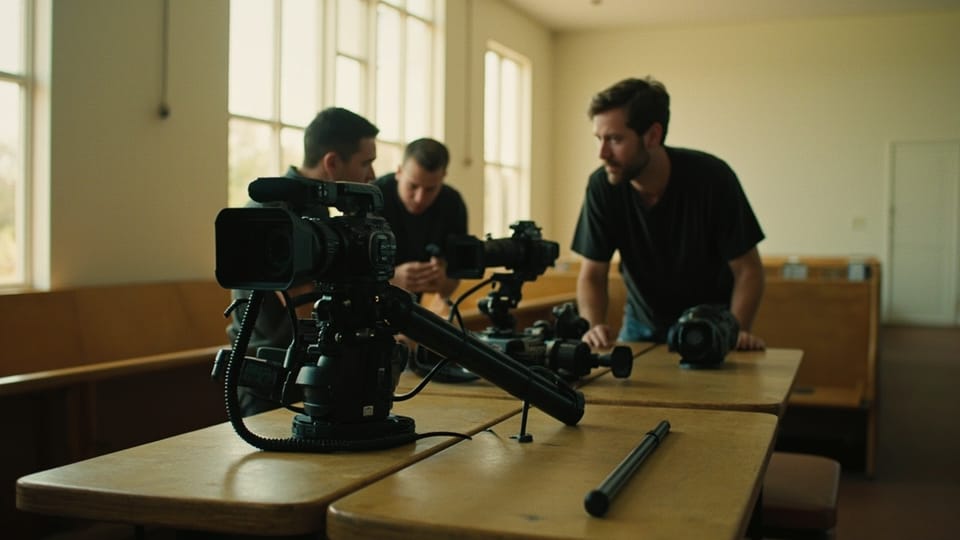
A church in a rented school hall buys a mirrorless body and a telephoto zoom, $1,140 at Canon’s current prices, mounts it on the balcony rail of the auditorium it moves into a year later, and cannot get the whole platform into the shot. The lens is too long. Not slightly too long. From 30 feet the widest frame that combination can hold is 12.3 feet across, and the platform is 24 feet wide. There is no setting that fixes it and no adapter to buy. The gear was correct for a room the church no longer meets in.
That is the shape of almost every camera mistake a church makes. The specification sheet was fine. The distance was wrong, or the operator did not exist, or the body stopped recording partway through the sermon because nobody checked the limit. This page prices five real builds against manufacturer pages read on 29 July 2026, does the lens arithmetic for three distances, and ends by telling you which one to buy.
The audio side of this, which matters more than any camera on this page, is in the church live streaming setup guide. If the sermon sounds like a voice at the bottom of a well, no camera in this price range will save the stream. Fix that first, then come back.
What camera should a church use for live streaming?
Five answers, by situation. Each one is the whole build for one camera position, including the box that gets the picture to the internet where one is needed.
Nobody will run it every week, and money is tight. A phone on a tripod, with audio taken from the sound desk by cable. An iPhone 17e is $599 for the 256GB model and records Dolby Vision up to 4K at 60 fps, checked 29 July 2026. A phone your church already owns costs nothing.
Nobody will run it every week, and there is a real budget. A pan-tilt-zoom camera on saved presets. The PTZOptics Move SE 12x is $1,319 with 255 presets and 802.3af Power over Ethernet, checked 29 July 2026. Add a Blackmagic ATEM Mini Pro at $349 and the whole position is $1,668 with no computer in the chain.
One trained person, camera more than 40 feet back. A superzoom camcorder. The Canon XA60 is $1,949, reduced from $1,999, with a 20x zoom covering 29.3 to 601mm in 35mm-equivalent terms, HDMI out, and two XLR audio inputs on a detachable handle, checked 29 July 2026.
One trained person, camera under 40 feet back, house lights dropped during the service. A studio camera with a larger sensor. The Blackmagic Studio Camera 4K Plus G2 is $1,555 with a 17.78 by 10mm Four Thirds sensor and dual native ISO at 0dB and 18dB gain, checked 29 July 2026. It is a body with a lens mount and no lens.
One trained person, camera under 40 feet back, house lights stay up. A mirrorless body and a telephoto zoom. The Canon EOS R50 body is $729.99, reduced from $779.99, and the RF-S 55-210mm is $409.99, checked 29 July 2026.
Every price on this page was read off the manufacturer’s own published page on 29 July 2026 and is linked at the claim. Where a page refused a request or printed no number, the gap is named rather than filled. Our method is on how we review.
What the whole thing actually costs
Nobody publishes this. Camera reviews price a body. Vendor pages price a camera. Neither prices the system, and the system is what the church has to pay for, because a camera with no way to reach the internet is a paperweight.
Every line below except the phone includes the ATEM Mini Pro switcher at $349, because a switcher with four HDMI inputs and a built-in streaming encoder removes the computer from the chain and takes you to four cameras before anything else changes.
- Phone one fixed shot, no switcher
- Camcorder Canon XA60, lens built in
- PTZ Move SE 12x, no operator needed
- Studio camera 4K Plus G2, body only
- Mirrorless R50 with a 55-210mm zoom
Every dollar here is a price read off the manufacturer's own page on 29 July 2026, plus one ATEM Mini Pro at $349 on every line except the phone. One assumption, stated so you can disagree with it: one camera position up to 150 people, two at 400, three at 1,200. PTZOptics shows single, multi and three-camera example systems on its own church page and puts no price on any of them. The studio camera line is body only. Blackmagic sells no lens with it, and no manufacturer page we could reach printed a US price for a Micro Four Thirds zoom, so that line is lower than the real number.
See the numbers
| Vendor | 75 people | 150 people | 400 people | 1,200 people |
|---|---|---|---|---|
| Phone | $599 | $599 | not offered | not offered |
| Camcorder | $2,298 | $2,298 | $4,247 | $6,196 |
| PTZ | $1,668 | $1,668 | $2,987 | $4,306 |
| Studio camera | $1,904 | $1,904 | $3,459 | $5,014 |
| Mirrorless | $1,489 | $1,489 | $2,629 | $3,769 |
Four things fall out of that shape.
The phone is not on the same scale as anything else. At one camera position it is a quarter of the cheapest alternative with a lens on it. The gap is so large that a church which cannot honestly answer the operator question should stop reading the rest of this page.
Below 150 people the curve is flat, which means the only decision is which build, not how many. A one-camera church pays the same at 75 people as at 150. Nothing about the hardware changes until a second angle appears, and a second angle is a want rather than a need.
The camcorder line climbs fastest, and it is the one churches most often plan around. Three Canon XA60 positions and a switcher is $6,196. Three PTZ positions and the same switcher is $4,306, and the PTZ build needs nobody standing behind it. Take it out to four positions and the camcorder build is $8,145 against $5,625. If the plan is three angles or more, the camcorder is the wrong shape of purchase, because you are paying for a viewfinder, a handle, a battery system, and two XLR preamps three or four times over when the sound desk is already handling audio.
The switcher is a cliff rather than a slope. The ATEM Mini Pro takes four HDMI inputs. A fifth camera position means the ATEM Mini Extreme at $1,249, checked 29 July 2026, which adds $900 to the build before the fifth camera is paid for. Plan the fourth camera as your ceiling or plan the switcher for eight from the start.
Is a camcorder better than a DSLR for a two-hour service?
For a stream, usually yes, and the reasons have nothing to do with picture quality. A camcorder is a device designed to run continuously on mains power with a human hand on a zoom rocker. A stills camera is a device designed to take photographs, which happens to shoot excellent video in short bursts. A Sunday service is not a short burst.
Five specific failures, in the order churches hit them.
The clip limit. Older stills bodies cut the recording at 29 minutes 59 seconds. It is largely gone from current bodies. Canon’s own page for the EOS R50 states “Longer than 30min video recording” as a feature, checked 29 July 2026, which tells you both that the limit was real and that it mattered enough to advertise its removal. Do not assume it. Find that claim on the page for the exact body you are buying, because the limit still lives in secondhand stock, and secondhand stock is what churches buy.
Heat. A stills body has a small sealed casing built around a sensor that was never meant to read out continuously for two hours. A camcorder is built around continuous recording, in a larger body with somewhere for the heat to go. The failure mode is ugly: the picture is fine through the singing, the body warms up, and the stream cuts during the sermon. Neither Canon page we read on 29 July 2026 printed a thermal runtime figure for the R50, so nobody can tell you the number in advance. That absence of a number is itself the argument. A camcorder’s runtime is not a specification anybody publishes either, because nobody thinks to ask.
Autofocus hunting. Canon fits the R50 with Dual Pixel CMOS AF II, checked 29 July 2026, and it is genuinely good. It is also designed to track a subject and reacquire focus when the frame changes, which is the last thing you want. A worship leader steps back, the system decides the drum kit is now the subject, and everybody watching at home sees the picture breathe in and out. The answer on any body is to lock focus manually before the service and never touch it. A camcorder gives you a focus ring and a switch. A stills body gives you a menu, and a volunteer will find the menu three weeks after you set it.
Power. A battery dies during the sermon, which is the quietest part of the service and the worst possible time for somebody to walk to the balcony. A camcorder runs from its supply with the battery off. A mirrorless body needs a dummy battery, a coupler that fits into the battery bay with a cable running out to mains. It is a cheap part that nobody remembers to order and every mirrorless build needs.
Audio inputs. The Canon XA60 carries two XLR terminals on a detachable handle plus four-channel linear PCM, checked 29 July 2026. That means the feed from the sound desk arrives on a balanced professional connector with its own gain control. A stills body has a 3.5mm jack expecting microphone level, which is where the overloaded, crunchy sound on so many church streams comes from.
Where the camcorder loses, stated plainly
Sensor size, and it is not a small loss. The Canon XA60, XA65 and VIXIA HF G70 all use a 1/2.3-inch sensor, checked 29 July 2026 on Canon’s own pages. The Blackmagic Studio Camera 4K Plus G2 uses a Four Thirds sensor that Blackmagic publishes as 17.78 by 10mm, and the 6K Pro uses a Super 35 sensor at 23.10 by 12.99mm, checked 29 July 2026. Those are not close. A 1/2.3-inch sensor gathers a fraction of the light and it shows the moment the house lights come down and a single spotlight hits the pulpit: noise in the shadows, a grainy wash across the back wall, and mud where a dark suit meets a dark curtain.
So the honest rule is about your room, not about your camera. A church that keeps the house lights up and the platform evenly lit can run a small-sensor camcorder for a decade and nobody will complain. A church that drops the house to near dark and lights only the platform has bought itself a low-light problem, and the fix costs either sensor area or stage lighting. Stage lighting is usually cheaper and it improves what the people in the room see too.
Blackmagic publishes dual native ISO at 0dB and 18dB gain for all three Studio Camera models, checked 29 July 2026. A dual native sensor has two hardware gain paths, so the higher one is not a digital boost applied to a noisy signal. That is what you are paying the extra money for, and in a dark room it is worth it.
What lens do I need from the balcony?
This is the question that sinks builds, and it has an exact answer that takes ten seconds of arithmetic.
For any lens quoted as a 35mm equivalent, the width of the shot equals the distance multiplied by 36 and divided by the equivalent focal length. The 36 is the width of a 35mm frame in millimeters. Distance in feet gives shot width in feet.
So from a balcony rail 70 feet from the platform, a 105mm equivalent lens frames 24 feet across, which is the whole platform. A 420mm equivalent lens frames 6 feet, which is one person head to toe. Anything in between is a matter of taste.
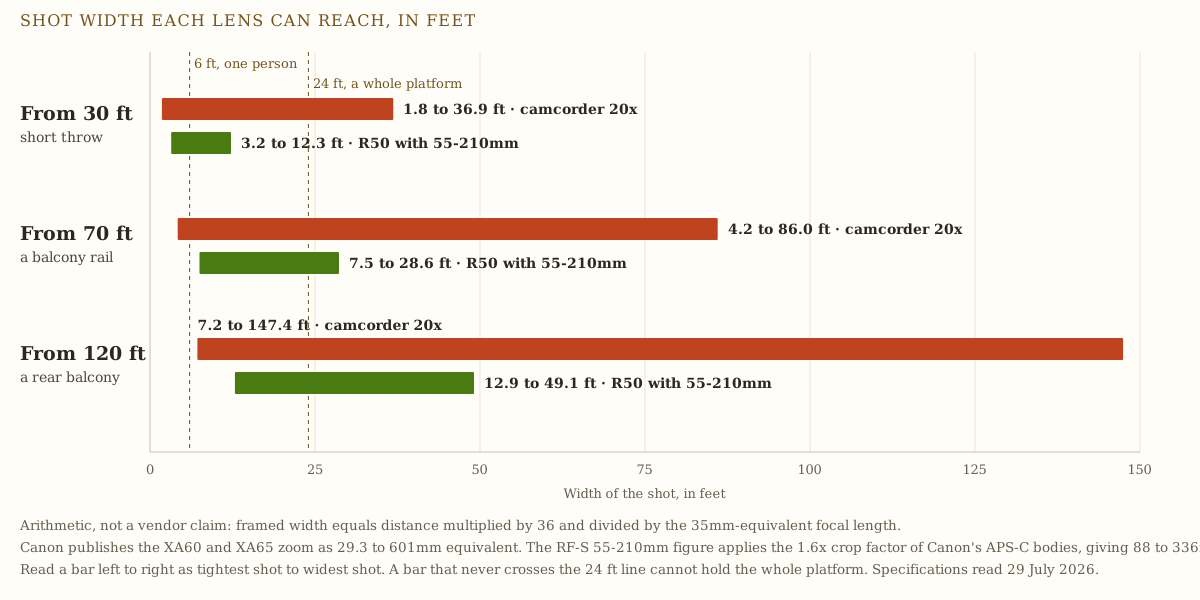
Two findings come straight out of that picture, and neither appears on any page currently ranking for this query.
A telephoto zoom cannot get wide enough up close. The RF-S 55-210mm on a Canon APS-C body covers 88 to 336mm equivalent, applying the 1.6x crop factor Canon uses across its APS-C range. From 30 feet, its widest frame is 12.3 feet. To hold a 24 foot platform with that lens you have to be 59 feet back. That is the mistake the church in the first paragraph made, and it is unfixable without buying a second lens.
A telephoto zoom cannot get tight enough far away. From a rear balcony 120 feet out, the same lens bottoms out at 12.9 feet wide. You will never get a head-and-shoulders shot of the preacher. The camcorder’s 601mm equivalent long end reaches 7.2 feet from the same seat, which is a full-body shot, and reaches 4.2 feet from 70 feet, which is head and shoulders.
That range is the actual argument for a superzoom camcorder, and it is the argument nobody makes because it requires doing the arithmetic. One lens, from one bolted-down position, covering everything from the whole room to a face. An interchangeable-lens build gets there with two lenses and somebody swapping them, or with one expensive zoom.
Take the table with you. The camera reach table is a CSV giving the equivalent focal length you need to frame 40, 30, 24, 16, 10 and 6 feet from every distance between 20 and 140 feet, plus the formula and the two lenses checked above. Measure from the camera position to the front of the platform, find your row, and compare the number against the range printed on the camera you are about to buy. If the camera you want does not cover your row, you have found out for free.
Which specifications actually decide it
Model names in this category change constantly. The specifications below do not.
| What it does | Why it decides the purchase | Where it sits in this page’s builds |
|---|---|---|
| Clean output, no menus or focus box burned in | A camera without it is unusable for streaming at any price | All five builds. Confirm on the page for the exact model |
| No recording time limit on the live output | A sermon is longer than 30 minutes | Camcorder and PTZ by design. Verify on any stills body |
| Mains or Power over Ethernet | A battery dies during the sermon | PTZOptics Move SE runs on 802.3af PoE. Studio Camera 4K Pro G2 takes Type 4 PoE. The mirrorless build needs a dummy battery |
| Full manual exposure, white balance and focus | Every automatic system hunts when the stage lights change | Camcorder gives you rings and switches. Stills bodies bury it in menus |
| Sensor area | Decides whether a dark room looks like a dark room or like noise | Four Thirds at 17.78 by 10mm, Super 35 at 23.10 by 12.99mm, or 1/2.3-inch. Not close |
| Reach, as a 35mm equivalent | Decides whether the shot you want exists from the seat you have | Canon’s 20x covers 29.3 to 601mm. Check yours against the reach table |
| A balanced audio input | The sound desk feed arrives at line level on XLR | Two XLR terminals on the XA60. A 3.5mm jack is not the same thing |
Notice what is absent. Resolution is not on the list. YouTube’s recommended bitrates are 10 Mbps for 1080p at 30 fps and 30 Mbps for 4K at 30 fps, checked 29 July 2026. A church streaming 1080p over a business connection is making a sensible choice, and a church streaming 4K is spending three times the upload for a picture most viewers will watch on a phone. Megapixel counts are not on the list either. A 24.2 megapixel sensor and a 2.07 megapixel sensor both output the same 1080p stream.
How much upload speed does a church live stream need?
Take the bitrate you plan to send and add half again for headroom. YouTube’s own recommendation for 1080p at 30 fps is 10 Mbps of video plus 128 Kbps of stereo audio, checked 29 July 2026, so a 1080p stream wants about 15 Mbps of dedicated upload. That is arithmetic, not a published figure: the headroom exists because a shared connection is never yours alone and an encoder that cannot keep up drops frames rather than degrading gracefully.
Two practical consequences. Run the encoder on a wired connection, because a stream is a sustained upload and wifi in a hall full of people is a contended medium. And test the upload at the hour the service actually happens, from the room the encoder will sit in, not from the office on a Tuesday.
Can you live stream a church service with a phone?
Yes, and for most churches it is the right answer. This is the paragraph the camera review sites will not write because there is no affiliate commission on a phone the church already owns.
A current phone has a good sensor for its size, computational processing that copes with mixed lighting, a wide lens, and an encoder built in. Point it at the platform from a fixed position, lock the exposure and focus with a long press, and it will hold a clean wide shot for two hours. The iPhone 17e records Dolby Vision up to 4K at 60 fps at $599 for 256GB, checked 29 July 2026.
Three things have to be true.
The audio comes from the sound desk, not the phone. A phone microphone at the back of a hall hears reflection, air handling, and the child three rows in front. This is the whole ball game and it is covered properly in the streaming setup guide.
The phone is on mains power and locked down. Not held. Not propped. A clamp on a tripod, a cable to the wall, notifications off, and airplane mode with wifi on so a call does not end the service.
It is a fixed wide shot and everybody accepts that. No zooming, no panning, no following the preacher. A locked wide shot that never wobbles reads as competence. A hand-held phone drifting around reads as an accident, and it is what makes a stream unwatchable.
The honest limit is reach. A phone’s main lens is a wide, so the phone has to be close enough that a wide frame is the frame you want. From the back of a 120 foot room a phone gives you a picture of a room with some people in it. If the platform is far away and you need it tight, the phone is out and you are back on the reach table.
For a church running its whole communication operation on one volunteer’s Thursday afternoon, the phone build is the one that survives contact with reality. That is the same argument as social media without a media team, applied to hardware.
The question that comes before the camera
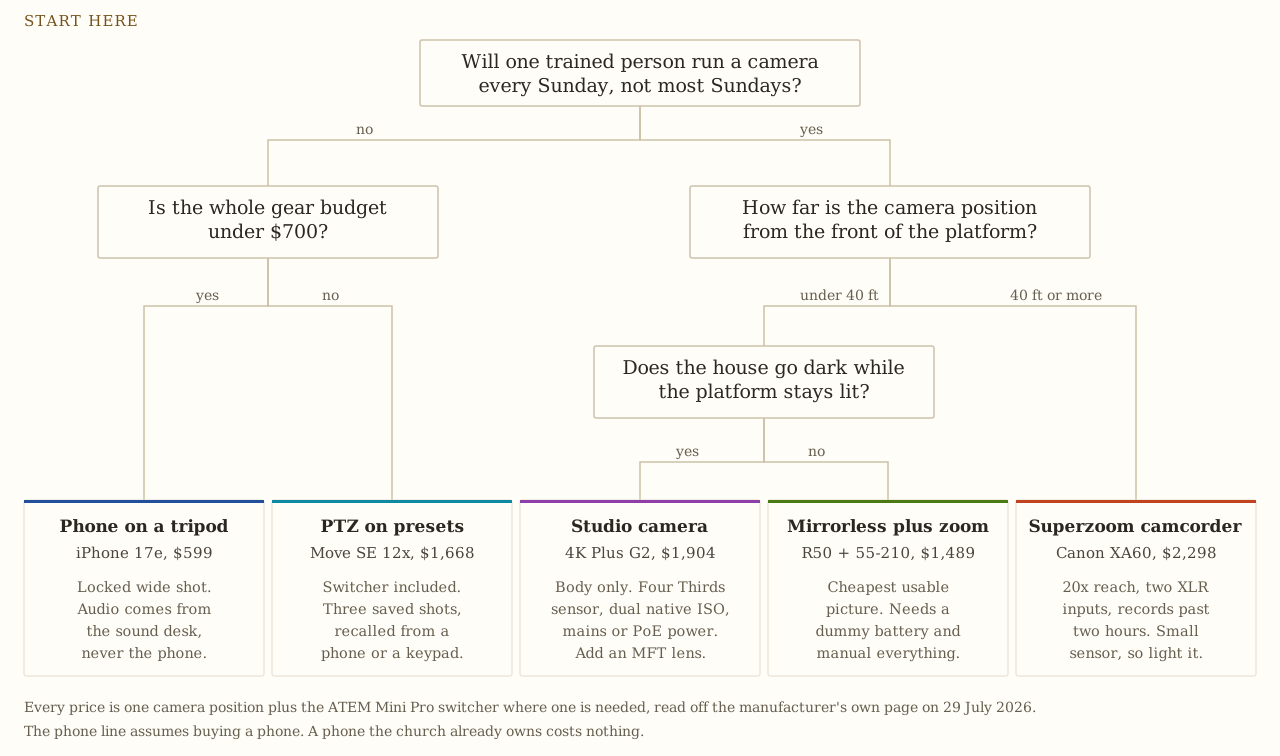
The tree starts with the operator because that is the gate everything else hangs from, and it is the question churches skip.
“We have somebody” usually means a college student who is home for the summer, or the one deacon who understands the equipment and also serves communion. A camera that needs a hand on it needs that hand fifty-two times a year, at the same time as the service, for the whole service. If you cannot name the person and their backup, buy a camera that does not need them.
A PTZ camera answers that question with hardware. The PTZOptics Move SE holds 255 presets with a stated preset accuracy of 0.1 degrees, checked 29 July 2026, which in practice means three saved shots: wide, pulpit, and the communion table. Somebody in the back row recalls a preset from a phone or a keypad between elements. That is a job a fourteen-year-old can do reliably, and it is the difference between a stream that runs every week and a stream that runs when the volunteer is in town.
The tradeoff is that PTZOptics builds the Move SE around a 1/2.8-inch Sony CMOS sensor at 1080p, checked 29 July 2026, which is a smaller sensor than the camcorder’s. The Move 4K range starts at $2,199 for the 12x with a 1/2.5-inch sensor and built-in auto-tracking to a stated 200 feet, checked 29 July 2026. Auto-tracking is worth testing before you rely on it. A camera that follows a preacher who walks is excellent. A camera that follows the wrong person during a baptism is a story your congregation will tell for years.
Worth naming: PTZOptics publishes prices on its product pages and publishes none on its own house of worship page, checked 29 July 2026. That page shows single, multi and three-camera example systems and never puts a number on any of them. Every vendor in this category does the same thing, which is why this page exists.
What not to buy
A webcam. The Elgato Facecam MK.2 is $139.99 with a fixed focus range of 30 to 120 centimeters and an 84 degree field of view, checked 29 July 2026. It is a good camera for a desk. Its focus range tops out at four feet. Point it at a platform 40 feet away and it cannot focus on the subject, at any setting, ever. Churches buy this every week because it is cheap and it says 1080p on the box.
Any part with no published price. Magewell’s USB Capture HDMI Gen 2 prints full specifications and no price, checked 29 July 2026. That is normal for gear sold through resellers, and it means you cannot budget from the product page. Get a written quote before it goes in the plan.
A discontinued lens. Canon’s page for the RF-S 18-150mm lists $569.99 and states the item is no longer available, checked 29 July 2026. The superzoom that would have solved the balcony problem on an APS-C body is off the market, which is a real reason the interchangeable-lens path is harder than it looks.
A camcorder whose output you have not confirmed. The Canon VIXIA HF G70 is $1,349 with the same 20x lens and the same 1/2.3-inch sensor as the XA60, $600 cheaper, checked 29 July 2026. The specifications on the page we read do not list a video output connector. That may be an omission on the page rather than on the camera. Confirm it with Canon in writing before you buy it for streaming, because a camcorder with no live output is a recorder.
Sony gear, from this page at least. Sony’s US electronics store refused an automated request on 29 July 2026, so no Sony model is named or priced here. Sony makes cameras churches use well. We could not read a number, so we print none.
Getting the picture to the internet
Three routes, and the choice sets what the volunteer has to do on Sunday.
Capture into a computer. The Elgato Cam Link 4K is $99.99 and captures 4K30 or 1080p60 over USB 3.0, checked 29 July 2026. Cheapest, most flexible, and it puts an operating system in the signal path. A computer that decides to install an update during the offering has ended more streams than any camera failure.
A hardware switcher that also encodes. The ATEM Mini Pro at $349 takes four HDMI inputs and streams over RTMP or SRT with no computer, checked 29 July 2026. It also carries a full audio mixer with a compressor, gate, limiter and six bands of parametric EQ, which is why it appears in every build on the chart above. One box, one power supply, one thing to turn on.
A hardware encoder on SDI. The Blackmagic Streaming Encoder HD is $599 and takes a single SDI input, checked 29 July 2026. This is the route for one camera at a long cable run, because SDI travels over coaxial cable in a way HDMI does not. It is also the reason the Canon XA65 costs $2,499 against the XA60’s $1,949 with the same lens and sensor: the extra $550 buys a 3G-SDI output. If the camera is 150 feet from the equipment rack, that $550 is the cheapest part of the solution.
If a second building or an overflow room needs the same feed, the ATEM Streaming Bridge is $305 and turns an ATEM stream back into SDI and HDMI at the far end, checked 29 July 2026.
Do you need a CCLI license to stream music?
Yes, if the stream carries congregational singing of copyrighted songs. Your Church Copyright License covers projecting and printing lyrics in the room. Streaming is separate. CCLI publishes a starting price of “Prices start from just $84 per year for churches already licensed with CCLI, or $108 for an average church (100 - 199 people),” checked 29 July 2026, and describes coverage for 450,000 worship songs and hymns performed live during online worship with auto-reporting from popular presentation software.
Put that in the same budget line as the camera. A church that spends $2,298 on hardware and skips a $108 license has mispriced the project by less than five percent and taken on the only risk in it that comes with a letter. The presentation software side of the reporting, and which packages report to CCLI automatically, is covered in presentation and lyrics software.
The decision
Answer three questions honestly and the purchase is decided.
Can you name the person who will run a camera every Sunday, and their backup? If not, buy the phone build at $599 or the PTZ build at $1,668. Do not buy a camera that needs a hand and then hope.
How far is the camera position from the front of the platform, and how wide is the shot you want? Multiply the distance by 36, divide by the width, and check that number against the camera’s published 35mm-equivalent range. If it does not cover your row in the reach table, the camera is wrong regardless of everything else about it.
Do the house lights come down during the service? If yes, buy sensor area or buy stage lighting. A 1/2.3-inch camcorder in a dark room is the one combination on this page that no setting will rescue.
For most churches reading this, the answer is the phone on a tripod with a cable from the sound desk, and the money saved goes into a matched pair of congregation microphones and a $108 streaming license. For a church with a real operator and a balcony, it is the Canon XA60 at $1,949 plus the ATEM Mini Pro at $349. For a church with three angles and no operator, it is three PTZOptics Move SE at $1,319 each plus the same switcher, $4,306 total, and nobody has to stand anywhere.
Every number on this page is in the streaming camera price sheet as a CSV: 28 models with the price exactly as the manufacturer printed it, the source URL, the date read, and a separate block listing the pages that would not give a number. Take it to your finance committee. Recheck the prices before you spend, because vendors change them and we date ours for that reason.
Once the stream runs, two decisions follow it. Whether the online count belongs in your attendance number, which is covered in measuring church attendance honestly. And where the recording lives afterward, which is a question about your website rather than about your camera.
Sources
Every price and specification above was read off these pages on 29 July 2026. Nothing on this page comes from a page we did not open.
- Blackmagic Design, Studio Camera technical specifications: $1,555 for the 4K Plus G2, $2,135 for the 4K Pro G2, $2,835 for the 6K Pro, plus sensor dimensions, dual native ISO and PoE support. Checked 29 July 2026.
- Blackmagic Design, ATEM Mini technical specifications: $349 Pro, $585 Pro ISO, $1,249 Extreme, $2,245 Extreme ISO G2, HDMI input counts, RTMP and SRT streaming, Fairlight audio tools. Checked 29 July 2026.
- Blackmagic Design, streaming hardware technical specifications: $599 Streaming Encoder HD, $785 Streaming Encoder 4K, $305 ATEM Streaming Bridge. Checked 29 July 2026.
- PTZOptics, Move SE: $1,319 for 12x, $1,489 for 20x, $1,649 for 30x, 1/2.8-inch Sony CMOS, 255 presets, 0.1 degree preset accuracy, 802.3af PoE. Checked 29 July 2026.
- PTZOptics, Move 4K: $2,199 for 12x, $2,589 for 20x, $2,969 for 30x, sensor sizes and auto-tracking ranges. Checked 29 July 2026.
- PTZOptics, house of worship solutions: example single, multi and three-camera systems with no prices printed. Checked 29 July 2026.
- Canon USA, XA60: $1,949, reduced from $1,999, 1/2.3-inch 4K UHD sensor, 20x zoom at 29.3 to 601mm equivalent, HDMI, two XLR terminals. Checked 29 July 2026.
- Canon USA, XA65: as low as $2,499, the same lens and sensor plus a 3G-SDI output. Checked 29 July 2026.
- Canon USA, VIXIA HF G70: as low as $1,349, regular price $1,399, same 20x lens, no video output connector listed in the specifications shown. Checked 29 July 2026.
- Canon USA, EOS R50: as low as $729.99, regular price $779.99, 24.2 megapixel APS-C sensor, “Longer than 30min video recording”, Dual Pixel CMOS AF II. Checked 29 July 2026.
- Canon USA, RF-S 55-210mm F5-7.1 IS STM: as low as $409.99. Checked 29 July 2026.
- Canon USA, RF-S 18-150mm F3.5-6.3 IS STM: $569.99 and listed as no longer available. Checked 29 July 2026.
- Elgato, Cam Link 4K: $99.99, 4K30 and 1080p60 over USB 3.0. Checked 29 July 2026.
- Elgato, Facecam MK.2: $139.99, fixed focus 30 to 120 cm, 84 degree field of view, 1080p60. Checked 29 July 2026.
- Magewell, USB Capture HDMI Gen 2: full specifications and no printed price, up to 2048x2160 and up to 120fps. Checked 29 July 2026.
- Apple, iPhone 17e: $599 for 256GB, $799 for 512GB, Dolby Vision up to 4K at 60 fps. Checked 29 July 2026.
- YouTube Help, recommended live encoder settings: 4 Mbps for 720p30, 10 Mbps for 1080p30, 30 Mbps for 2160p30, 128 Kbps stereo audio. Checked 29 July 2026.
- CCLI, streaming licensing: “Prices start from just $84 per year for churches already licensed with CCLI, or $108 for an average church (100 - 199 people)”, coverage for 450,000 songs performed live during online worship. Checked 29 July 2026.
Two pages would not give a number on 29 July 2026 and nothing on this page depends on them. Sony’s US electronics store refused an automated request, so no Sony camera is named or priced here. Panasonic’s US lens listing returned a 404, which is why the Blackmagic studio camera build on the chart is priced body only rather than with a Micro Four Thirds zoom on it.