Seven words end it: the consent, quiet hours, and opt-out rules for church texts
The consent standard a church has to meet, the nonprofit carve-out at 47 CFR 64.1200(a)(2), the seven words that revoke consent, the ten business day clock, and what never goes by text.

A woman in her sixties replies to the church’s Tuesday text with four words: “please take me off.” Nobody at the church reads replies, because the platform inbox is a tab nobody has opened since the account was set up. She gets the Wednesday devotional, the Thursday volunteer reminder, and the Sunday weather update. On Monday she phones the office and asks to be removed from the church’s membership roll.
The church broke a federal rule three times that week. Nobody on staff knew there was a rule.
This page is the rule set for both halves of that: the law a church has to follow when it sends a text, and the courtesy that keeps a congregation reading. Pricing, throughput, and which vendor to use are worked out separately in church texting services priced by congregation size. The carrier registration that decides whether your messages arrive at all sits in the 10DLC rule that silently blocks church texts. What follows is what you are allowed to send, to whom, at what hour, and what happens when somebody says stop.
Does the TCPA apply to a church text?
Yes, and in two different ways depending on what the message says.
The base rule is at 47 CFR 64.1200(a)(1), which bars any autodialed call, and a text is a call for this purpose, to “any telephone number assigned to a paging service, cellular telephone service, specialized mobile radio service, or other radio common carrier service” unless the call is “made for emergency purposes or is made with the prior express consent of the called party.”
The second rule at 64.1200(a)(2) covers a text “that includes or introduces an advertisement or constitutes telemarketing.” For a business, that message needs prior express written consent. For a church, the same paragraph carves out a lower standard in its own words:
other than a call made with the prior express written consent of the called party or the prior express consent of the called party when the call is made by or on behalf of a tax-exempt nonprofit organization
That is the entire nonprofit carve-out, and church staff routinely read it as something it does not say. It does not exempt a church from consent. It drops the requirement that the consent be signed. A 501(c)(3) church may text a fundraising appeal on spoken permission where a bookstore would need a signature. Both of them need permission.
So the standard for every church text, promotional or not, is prior express consent: the person asked to be texted about this. A phone number written on a nursery inquiry card is not consent to a giving appeal, and the fact that the church is a nonprofit does not make it one.
The wrinkle that makes a lawyer shrug
An autodialer is defined at 64.1200(f)(2) as “equipment which has the capacity to store or produce telephone numbers to be called using a random or sequential number generator and to dial such numbers.” In Facebook v. Duguid, decided 1 April 2021, the Supreme Court held that a device qualifies only if it can “store a telephone number using a random or sequential number generator, or to produce a telephone number using a random or sequential number generator.” A church texting platform that sends to a stored list of members does not generate numbers randomly, so on that reading it may fall outside 227(b) altogether.
Do not build a policy on that reading, for three reasons. Carriers filter on consent whether or not a court would hold you liable, and a filtered message never arrives. Several state statutes use a broader definition of automated dialing, covered further down. And a church is trying to be the kind of institution a member trusts with a phone number, which is a higher bar than winning a case.
What “prior express consent” looks like on paper
Put this sentence on the connection card, the web form, the class registration, and the volunteer signup:
I agree to receive text messages from [Church name] about Sunday closures and schedule changes. Message frequency varies. Message and data rates may apply. Reply STOP to opt out, HELP for help.
Name the church. Name the purpose. Both are load-bearing. CTIA’s Messaging Principles and Best Practices, the wireless industry document carriers enforce against, tells a sender that a call to action should make the consumer aware of “the program or product description,” the number the message will come from, “the specific identity of the organization or individual being represented in the initial message,” clear language about opt-in, and how to opt out. The same document says a consent “should apply only to the campaign(s) and specific Message Sender for which it was intended or obtained.”
That is the sentence CTIA writes to stop a retailer from moving a shopper onto a marketing list. Read it as a church and it says something plainer. Consent travels with the purpose, not with the number.
CTIA then lists the fields a sender should retain against every opt-in: the timestamp, the acquisition medium, a capture of the language and action used to secure consent, the specific campaign it was given for, the IP address where one applies, the phone number, and the identity of the person who consented. Seven fields. The church that keeps them can end a dispute in ten seconds; the church that keeps none is arguing with a member’s memory.
Two of those fields are the ones churches skip. The exact wording the person saw matters because consent to “church updates” and consent to “closures” are different permissions, and a year later nobody remembers which form was on the table. The specific campaign matters because it is the field that stops the prayer chain list from quietly becoming the fundraising list.
We built the log as a spreadsheet so a church can start it this week without buying anything: texting-etiquette-consent-log.csv. Fourteen columns, one row per number, covering the seven CTIA fields plus who wrote the row, the opt-out date, the method, and the words the person used. The second row of the file is format guidance rather than data, so delete it once the first real entry is in.
Keep that file in the church’s own storage as well as inside the vendor. Platforms get replaced every few years, and the consent history is the one thing a migration usually leaves behind. The same argument covers every other member record the church holds, which is the subject of your church database holds more than a retailer’s.
The seven words, and the ten business day clock
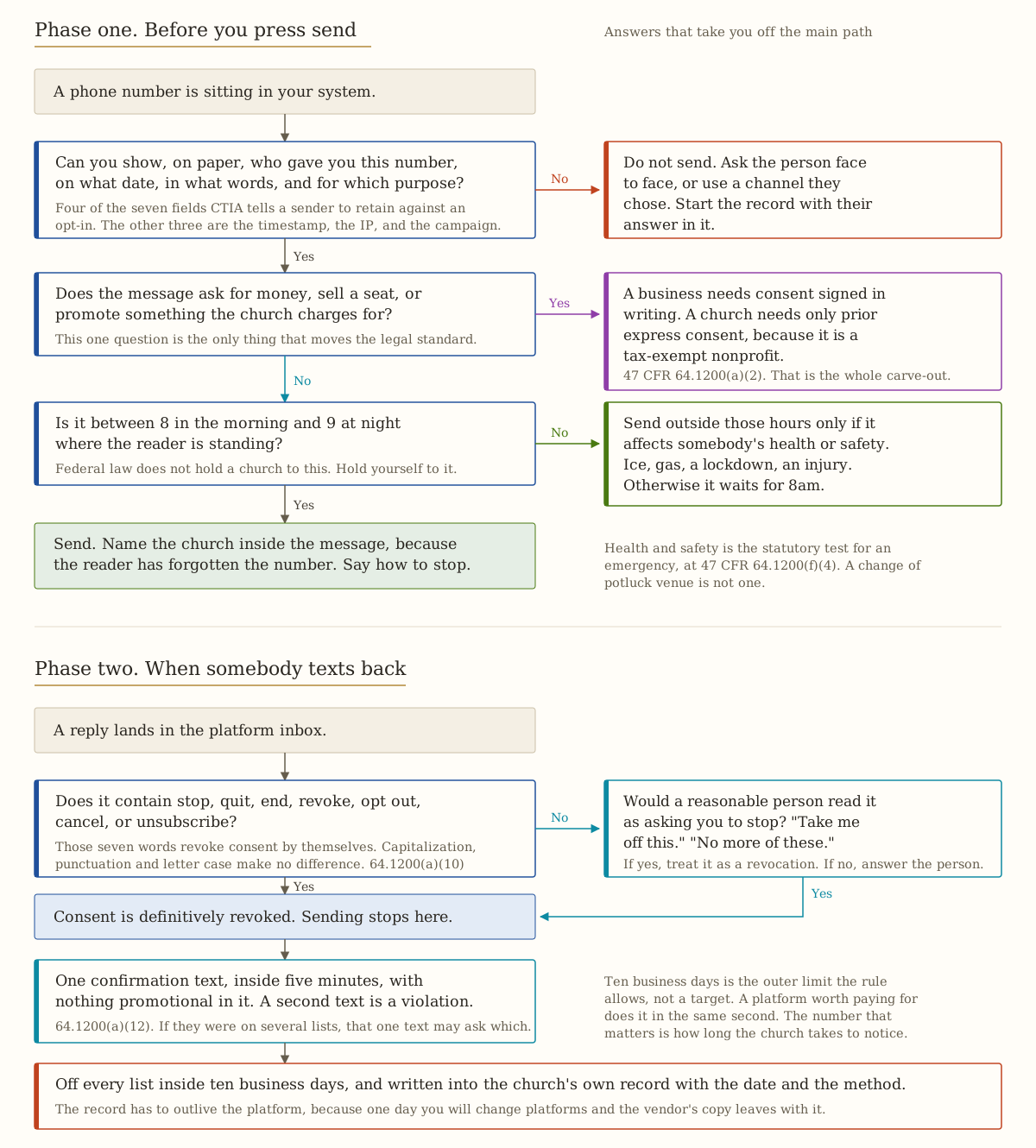
Since 11 April 2025, when the FCC’s revocation amendments took effect, this has been the sharpest edge in the rule set. 47 CFR 64.1200(a)(10) says a called party may revoke consent “by using any reasonable method,” then names the methods that count automatically. Replying to a text with any of these seven words is a revocation per se:
stop, quit, end, revoke, opt out, cancel, unsubscribe
Once a called party uses one of those methods, the regulation says, “that consent is considered definitively revoked and the caller may not send additional robocalls and robotexts.” CTIA puts the operational version of the same rule to senders: “the validity of a Consumer opt-out should not be impacted by any de minimis variances in the Consumer opt-out response, such as capitalization, punctuation, or any letter-case sensitivities.” A reply reading “Stop.” with a period on the end counts, and so does “STOP!!”.
Anything else still counts if it reads like a request to stop. The regulation is explicit: where a reply “uses words other than” the seven, “the caller must treat that reply text as a valid revocation request if a reasonable person would understand those words to have conveyed a request to revoke consent.” “Please take me off.” “No more of these.” “Wrong number.” All of them end it.
Three consequences follow, and most church platforms are configured against all three.
You cannot name one channel and refuse the rest. The regulation closes with a flat prohibition, that senders “may not designate an exclusive means to request revocation of consent.” A reply text works. A phone call to the office works. An email works. CTIA says the same thing from the other side, that senders “should support multiple mechanisms of opt-out, including phone call, email, or text.” If the only documented way off your list is a keyword, your church has no opt-out procedure.
One confirmation text, and only one. 64.1200(a)(12) permits a single message confirming the revocation, with no marketing in it. Send it inside five minutes and it is presumed to sit inside the person’s existing consent. Take longer and the sender has to show the delay was reasonable. If the person was on several of the church’s lists, that one confirmation may ask which lists they meant, and until they answer, everything requiring consent stops.
Ten business days is the ceiling, not the target. The rule requires that revocations “must be honored within a reasonable time not to exceed ten business days from receipt of such request.” Ten business days is two calendar weeks. A church that uses the full allowance is telling a member it took two weeks to hear the word stop. The number to measure at your own church is how long a reply sits in an unopened platform inbox.
The fix is one line in the sending policy: a named person reads that inbox every weekday.
Quiet hours: the federal rule that does not bind you
Every write-up of church texting quotes 8am to 9pm. The regulation those hours come from does not reach a church.
64.1200(c)(1) prohibits initiating “any telephone solicitation” to a residential subscriber “before the hour of 8 a.m. or after 9 p.m. (local time at the called party’s location).” Then 64.1200(f)(15) defines telephone solicitation as a call or message “for the purpose of encouraging the purchase or rental of, or investment in, property, goods, or services,” and excludes any message “by or on behalf of a tax-exempt nonprofit organization.”
Read those two together. The federal quiet hours attach to solicitation, and a tax-exempt church’s messages are not solicitation, so 8am to 9pm does not legally bind a church text at all.
Which means the church has to bind itself, and write down the hour it chose, because the alternative is a volunteer deciding at 10:40pm that the potluck venue change cannot wait.
Set the window at 8am to 9pm in the reader’s local time and cross it only for something covered by the emergency definition at 64.1200(f)(4): “calls made necessary in any situation affecting the health and safety of consumers.” That test is usefully strict. Ice on the roads at 6:40am affects safety. A gas leak in the fellowship hall affects safety. A lockdown at the school next door affects safety. A room change, a resource link, and a reminder about next month’s sign-up sheet do not, and every one of those sent at 6:40am costs the church the attention it needs on the morning that matters.
A death in the congregation is the hard case, because it does not fit the health and safety definition and it is still the message most worth sending before breakfast, since the alternative is that people hear it secondhand. Decide that one as a church, write down who decides it, and know that you are deciding on courtesy rather than on the regulation.
If your congregation spans time zones, and any church with college students and deployed members does, the local time in the rule is the reader’s, not the office’s.
What a church may never text
Part of the list below is law. The rest is the reason a congregation keeps reading what the church sends.
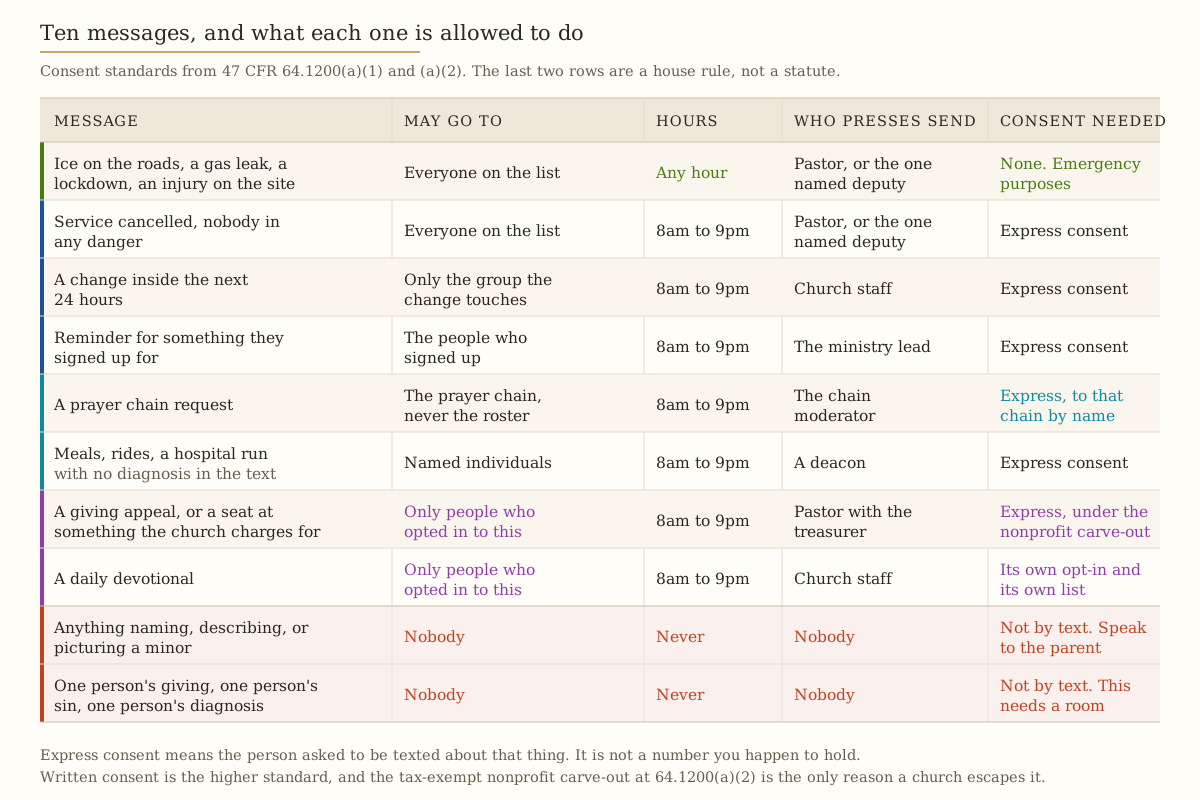
Anything naming, describing, or picturing a minor. No names, no photographs, no room assignments, no “Ethan left his coat in the youth room.” A text forwards in two taps, screenshots in one, and lands on a device the child does not control. When a message concerns a specific child, it goes to that child’s parent, and the youth leader texting a teenager directly happens on a channel a parent can see. CTIA’s content rules already require senders to prevent messages that “invade privacy,” “cause safety concerns,” or fail “age-gating requirements,” and a church should be well inside a line the wireless industry drew for advertisers.
One person’s giving. The amount, the shortfall, and the gentle reminder that a pledge is behind all stay out of the channel. Giving is the most sensitive record a church holds, and a channel that autocompletes recipients is how a treasurer sends one member’s pledge history to the wrong Sarah. Where giving data lives and what it costs to keep it there is worked out in what giving platforms actually cost your church.
A pastoral matter. A diagnosis, a marriage in trouble, a confession, a discipline process, a job loss. These need a person in a room, and a text about them is a permanent, forwardable, searchable record of the worst week of somebody’s life.
Medical detail in a prayer request. Send what the family approved, in the family’s words, and stop there. HIPAA does not apply to a congregation, which raises the standard rather than lowering it, because nothing outside the church will stop a prayer chain from turning a diagnosis into gossip. Give the chain a moderator with authority to strip last names, hold a message, and end a thread that has drifted from prayer into speculation.
A fundraising appeal to a list that opted in for closures. This is both the courtesy failure and the fastest route to a filtered number, because carrier filtering keys on the gap between what a campaign is registered to send and what it sends.
Everything else that is not urgent belongs in the newsletter, the Sunday announcements, or the schedule you already keep in a content calendar.
The state rules that close the gap federal law leaves open
State mini-TCPAs are where the Duguid problem gets solved against you, and they reach text messages by name.
Florida’s telephone solicitation statute, Fla. Stat. 501.059, defines a “telephonic sales call” as “a telephone call, text message, or voicemail transmission to a consumer for the purpose of soliciting a sale of any consumer goods or services.” Its automated-messaging prohibition at 501.059(8)(a) bars an unsolicited telephonic sales call “if such call involves an automated system for the selection and dialing of telephone numbers” without prior express written consent.
Compare that phrase to the federal definition. Florida says automated system for the selection and dialing of telephone numbers. Federal law says random or sequential number generator. Every church texting platform selects and dials from a list, so a message that escapes 227(b) after Duguid can still sit squarely inside the Florida statute. Damages run to $500 per violation, trebled to $1,500 where the defendant acted willfully or knowingly, the same structure as 47 U.S.C. 227(b)(3).
Two Florida provisions matter more to a church than the headline rule.
The statute reaches a church only when the message solicits a sale of consumer goods or services, so closure alerts and prayer requests sit outside it. A text selling seats at a marriage retreat, a spot at day camp, or a book from the church table is a different animal, and that is exactly the message a well-meaning ministry lead sends without asking anybody.
And 501.059(5) prohibits an outbound “telephone call, text message, or voicemail transmission” to anyone who has said they do not wish to receive one, where the message is made “on behalf of a charitable organization for which a charitable contribution is being solicited.” Florida wrote the charitable case into the opt-out rule on purpose. A church that keeps texting appeals to somebody who said stop is inside that sentence, carve-out or no carve-out.
One more federal layer sits beside the TCPA, and it does not rescue a church either. The FTC’s Telemarketing Sales Rule at 16 CFR 310.6 exempts charitable work from exactly one provision, stating that “solicitations to induce charitable contributions via outbound telephone calls are not covered by 310.4(b)(1)(iii)(B),” the national do-not-call requirement. Everything else in the rule stands. The pattern repeats at every level of this: a narrow carve-out for charity, and no general permission.
Florida is the state we checked, because the Legislature publishes the text in a form we could open on 29 July 2026. Oklahoma, Washington, and Maryland all run their own versions with different triggers. If your congregation crosses a state line, and most do, read your own statute rather than assuming the federal answer travels.
Two prices on a careless habit
The federal exposure is arithmetic. 47 U.S.C. 227(b)(3) gives a private right of action for “actual monetary loss from such a violation, or to receive $500 in damages for each such violation, whichever is greater,” and lets a court treble the award where the violation was willful or knowing. Each message is a violation. So the number is the size of the unconsented group times the number of sends.
| Numbers with no consent record | One send at $500 | One send, trebled at $1,500 |
|---|---|---|
| 25 | $12,500 | $37,500 |
| 100 | $50,000 | $150,000 |
| 400 | $200,000 | $600,000 |
Nobody is suing a 90-member congregation over a Christmas Eve reminder. The exposure matters because it is the reason the platform enforces consent even when the church does not care to, and because a church that imports a spreadsheet of 400 numbers it inherited from a former administrator has manufactured that column on the right in an afternoon.
The second price is smaller and it arrives every month. Message volume is what a texting platform bills for, so restraint shows up on the invoice, and the gap widens fast with congregation size.
Here is the arithmetic against Clearstream’s published plan ladder, read on 29 July 2026. One credit per recipient per send, which holds for a message inside a single segment. Annual cost is the cheapest plan whose included credits cover that month, times twelve, with Clearstream’s published 16 percent annual discount applied.
| People on the list | 1 send a month | 4 sends a month | 13 sends a month |
|---|---|---|---|
| 120 | $292 | $292 | $494 |
| 300 | $292 | $292 | $998 |
| 900 | $292 | $998 | $2,006 |
| 3,000 | $998 | $2,006 | $9,566 |
At 120 people the discipline is free, because the entry plan absorbs about ten sends a month before it runs out. At 900 the church that texts three times a week pays roughly seven times the church that texts once a month. At 3,000 it pays about $8,600 a year more, for the privilege of being ignored.
Which platform you are on decides how steeply that curve bends, because the vendors split on what happens after the included messages run out. Clearstream moves you up a tier. Text In Church stops adding tiers above 2,500 messages a month and bills overage at 3 cents a message, so four sends a month to a large congregation lands almost entirely in overage.
- Clearstream
- Text In Church overage above 2,500 a month
Our arithmetic from each vendor's published pricing page on 29 July 2026, at four sends a month and one credit per recipient per send. Clearstream: cheapest plan covering the volume, times twelve, less the published 16 percent annual discount. Text In Church: the published annual price of the cheapest plan that fits, plus overage at the published 3 cents a message above the Premium plan's 2,500.
See the numbers
| Vendor | 120 people | 300 people | 900 people | 3,000 people |
|---|---|---|---|---|
| Clearstream | $292 | $292 | $998 | $2,006 |
| Text In Church | $369 | $668 | $1,363 | $4,387 |
Two conclusions come out of that shape. Volume pricing punishes a chatty church far harder than a large one, and a plan with per-message overage turns every unnecessary send into a line item. Compare vendor by vendor in church texting services priced by congregation size, which carries the full set at four congregation sizes.
The wholesale floor underneath all of it is public. Telnyx publishes $0.004 per message part for outbound US 10DLC SMS, plus carrier fees of $0.0035 at AT&T and $0.0045 at both T-Mobile and Verizon. A single send to 900 people costs somewhere near $7.65 in wholesale traffic. Everything above that on your invoice is the platform, the compliance work, and the support desk, which is a fair thing to pay for and a useful number to hold in your head while reading a tier sheet.
The registration layer, in one paragraph
None of the above matters if the message does not arrive. Text sent by software to a person runs through A2P 10DLC registration, and The Campaign Registry states plainly that “direct registration with TCR is not available for Brands,” so your vendor registers the church or nobody does. The registry’s own framing is that “Brands, CSPs, and messaging content are all known upfront, meaning both the ‘Who’ and the ‘What’ of a campaign are traceable.” Your registered campaign declares what kind of messages you send. Sending outside that declaration is how a church registered for service alerts gets throttled the week it starts sending appeals, which makes the courtesy rules above a delivery matter and not only a manners matter. The registration mechanics, the three questions to put to your vendor in writing, and the throughput problem on a 900-person emergency send are worked through in the 10DLC rule that silently blocks church texts. The registration fee itself is small where a vendor publishes it at all: SimpleTexting lists a “$4 one-time carrier registration fee”, and the same page states that “Nonprofits, churches, and other tax-exempt organizations receive 15% off any of our monthly plans.” Twilio’s A2P fee pages returned 404 at every URL we tried on 29 July 2026, so no brand vetting figure appears here.
Who is allowed to press send
Two names for closures: the pastor, and one designated elder or administrator. Pastoral crisis messages go through the pastor. The prayer chain has a moderator. The ministry lead running an event sends reminders to the people who registered for that event and to nobody else. Volunteers do not text the congregation on their own initiative, ever.
Write it on one page and keep it beside the platform login. We wrote the page: texting-etiquette-sending-policy.md. Nine sections covering who may send what, the never list, the hours, a volume ceiling, the consent sentence, the opt-out procedure, your carrier registration details, a scheduled test, and the quarterly review. Every decision your church has to make is in square brackets, and a copy with the brackets still in it is a piece of paper rather than a policy.
Two lines in that document do more work than the rest combined. The volume ceiling, because it is the only thing that stops six ministries each sending a reasonable number of messages. And the scheduled test, because a channel nobody has tested since the last emergency is not a channel.
Consent collection also has to be built into the moment a visitor first hands over a number, which is a different problem with its own failure modes, covered in a guest follow-up system one volunteer can run.
What to do this week
Your church is in one of three states. Find yours and do the work in that row, not the row below it.
No consent record exists. This is most churches with a texting platform. Do not send anything except genuine emergencies until you have one. Start the CSV, put the consent sentence on every form the church uses, and rebuild the list from the next number you collect rather than from the spreadsheet you inherited. A list of 200 numbers you can prove beats a list of 600 you cannot, and the second one is the one that generates the phone call from the member’s son who practices law.
A record exists, and replies go nowhere. Open the platform inbox. Read every reply in it. Honor every opt-out you find today, log it, and then assign that inbox to a named person in the policy with a stated cadence. Confirm in the platform settings that the seven keywords and a plain-language reply both trigger removal, and that removal hits every list rather than the one they replied to.
A record exists and replies get read. You are past the part most churches never finish, and three things remain. Write the hours and the volume ceiling down so they survive a staff change. Ask your vendor in writing which campaign use case the church is registered under and what it permits. Then send one test message at 6:40am on a clear Tuesday and confirm it lands on two different carriers, because a test on a clear Tuesday is the only way to know the channel works before the morning the roads are ice.
Sources
Every page below was opened on 29 July 2026 and every quotation above was read off it.
- Legal Information Institute, Cornell Law School, 47 CFR 64.1200, Delivery restrictions. Consent standards at (a)(1) and (a)(2), revocation and the ten business day limit at (a)(10), the confirmation text at (a)(12), quiet hours at (c)(1), and the definitions at (f)(2), (f)(4) and (f)(15). Checked 29 July 2026.
- Legal Information Institute, Cornell Law School, 47 U.S.C. 227, Restrictions on the use of telephone equipment. The $500 per violation figure and treble damages at (b)(3). Checked 29 July 2026.
- CTIA, Messaging Principles and Best Practices, May 2023. Call-to-action disclosures, the one-opt-in-per-campaign rule, the seven consent fields to retain, opt-out mechanisms, and the content rules including age gating. 25 pages, PDF. Checked 29 July 2026.
- Supreme Court of the United States, Facebook, Inc. v. Duguid, No. 19-511, decided 1 April 2021, via the Legal Information Institute. The autodialer holding. Checked 29 July 2026.
- Florida Legislature, Fla. Stat. 501.059, Telephone solicitation. The definition of a telephonic sales call at (1)(j), the automated dialing prohibition at (8)(a), and the charitable-solicitation opt-out at (5)(b). Checked 29 July 2026.
- Federal Register, Strengthening the Ability of Consumers To Stop Robocalls, 89 FR 15756, published 5 March 2024, the FCC final rule that added 64.1200(a)(10) and (11). Checked 29 July 2026 through the Federal Register API, because the HTML page redirected our request to an interstitial.
- Federal Register, Strengthening the Ability of Consumers To Stop Robocalls, 89 FR 82518, published 11 October 2024, the announcement of effective dates. Its own text: “The effective date for the amendments to 47 CFR 64.1200(a)(9)(i)(F) and (d)(3) and the addition of 47 CFR 64.1200(a)(10) and (11), published March 5, 2024, at 89 FR 15756 is April 11, 2025.” Checked 29 July 2026 through the Federal Register API.
- Legal Information Institute, Cornell Law School, 16 CFR 310.6, Exemptions to the Telemarketing Sales Rule. Confirms that charitable solicitation is exempted only from a single provision of the rule rather than from the rule as a whole. Checked 29 July 2026.
- The Campaign Registry, homepage and A2P 10DLC overview. Brands cannot register directly, and campaign content is declared in advance. Checked 29 July 2026.
- Telnyx, messaging pricing. Base and per-carrier fees for outbound US 10DLC SMS. Checked 29 July 2026.
- Clearstream, pricing. Plan ladder, included credits per plan, and the 16 percent annual discount used in both tables and the chart. Checked 29 July 2026.
- Text In Church, pricing. Basic, Pro and Premium annual prices, the included messages per month on each, and the 3 cents a message overage rate. Checked 29 July 2026.
- SimpleTexting, pricing. The $4 one-time carrier registration fee and the 15 percent discount for churches and tax-exempt organizations. Its base plan price is stated two ways on that page, so no SimpleTexting figure appears in the chart. Checked 29 July 2026.
Three pages refused us on 29 July 2026 and nothing above rests on them. The FCC’s own consumer page on stopping robocalls returned HTTP 403, so the rule is cited from the codified regulation and the Federal Register record instead. Flocknote’s pricing page returned HTTP 403, so no Flocknote figure appears anywhere on this page. Twilio’s A2P 10DLC fee pages returned HTTP 404 at every URL we tried, so no brand registration or campaign vetting fee is quoted. Nothing here is legal advice. Where a claim turns on law, the primary source is linked at the sentence that makes the claim, so you can check it without trusting us.