
Church texting services priced at 120, 300, 900, and 3,000 people
Prices checked 29 July 2026 for Clearstream, Text In Church, EZ Texting, SimpleTexting, Flocknote, Twilio and Tithe.ly, worked out at four congregation sizes, plus the 10DLC registration.
Updated

You asked three church texting vendors what they charge and got $29, $37, and an invitation to book a demo. None of those numbers answers the question you actually have, which is what it costs to reach every household at 9pm on a Saturday when the water main breaks and Sunday is off.
The reason the quotes do not compare is that almost nobody sells church text messaging by the member. They sell it by the outbound segment. A church with 300 people on the list and a church with 3,000 pay the same headline price and completely different bills, because one broadcast costs 300 units and the other costs 3,000. One vendor in this piece breaks that rule, and it changes the answer for large churches.
Count segments, not members
Mass text messaging for a church is priced by what leaves the building, not by who sits in the pew. Three rules do most of the arithmetic.
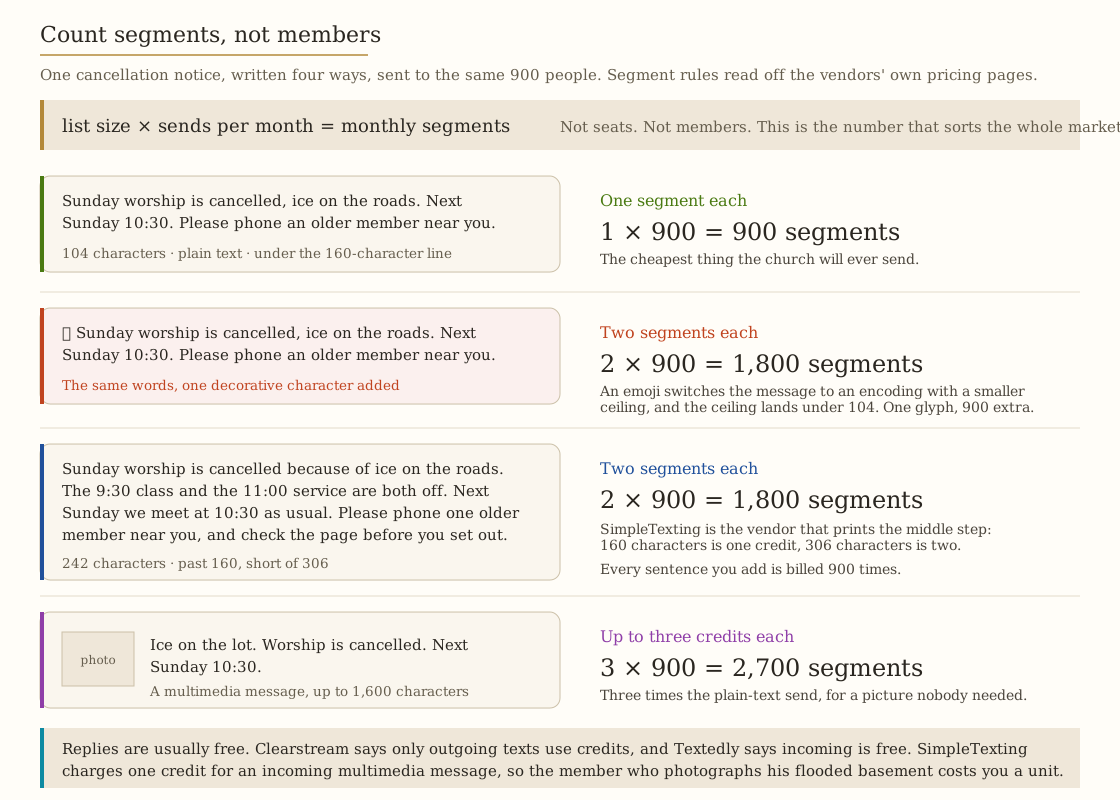
A plain message up to 160 characters is one segment. Go past 160 and it splits. EZ Texting states this on its pricing page: “1 SMS message (160 characters or less) = 1 credit,” and “1 MMS message (up to 1600 characters, may include a photo, GIF, or video) = up to 3 credits.” SimpleTexting prints the middle step that everyone else leaves out: 160 characters is one credit, 306 characters is two, an outbound MMS is three. Clearstream says the same in different words, that a text to a list of 100 people uses 100 credits and that longer messages or messages carrying media use more.
An emoji is expensive. Adding one switches the message to a character encoding with a smaller segment size, so a message that fit in one segment can suddenly cost two across your entire list. On a 900-person send, one decorative emoji costs 900 extra segments.
Incoming replies are usually free, with one exception worth knowing. Clearstream is unambiguous: “All incoming texts are free. All emails are free. Only outgoing texts use credits.” Textedly says incoming messages are “completely free”. SimpleTexting charges one credit for an incoming MMS, so a member who replies with a photograph of the flooded basement costs you something. That matters, because two-way pastoral conversation is the best thing a church does with a phone number and the thing churches ration when they misread the pricing.
So the number you need before you shop is one line: list size x sends per month = monthly segments. Not seats. Not members. Segments.
Written four ways, the same cancellation notice costs between 900 and 2,700 segments on the same list.
What the vendors publish
Every figure in this piece came off the vendor’s own public page on 29 July 2026. Fee schedules move, so confirm before you sign. Our review method covers what we verify, what we refuse to estimate, and when we recheck.
| Service | Entry price | What that buys | Overage |
|---|---|---|---|
| Clearstream | $29/mo | 1,250 credits, 1 number, unlimited email | Credit packs, or move up a tier |
| Text In Church | $37/mo | 500 texts, 1 local number, unlimited contacts | 3 cents per text |
| EZ Texting Launch | $25/mo | 500 credits, telecom fee charged | 4 cents per credit |
| SimpleTexting | $39/mo | 500 credits, unlimited contacts, local number included | 5.5 cents per credit |
| Textedly | $29/mo | Not published as a table | Not published |
| Twilio | $1.15/mo | One local number, nothing else | $0.0083 per segment plus carrier fee |
| Tithe.ly All-Access | $119/mo | 250 texts a month inside a six-product bundle | Not published |
| Flocknote Starter | Free to $169/mo | Unlimited texts and email, priced by member count | No per-message meter |
| Subsplash One | Not published | Texting listed as an included feature | Not published |
Three of those rows are the useful ones. Clearstream, Text In Church, and Flocknote publish a full ladder with the allowance printed next to each price, so you can price your church without talking to anyone. EZ Texting, SimpleTexting, and Textedly publish an entry price and then move you to a calculator, which means the number you see is the number for the smallest customer they have.
The same church at four sizes
Four congregations, each sending broadcasts to everyone on the list. Grace has 120 people opted in and sends twice a month. Trinity has 300 and sends weekly. Redeemer has 900 and sends weekly. Northside has 3,000 and sends weekly.
| Monthly segments | Clearstream | Text In Church | Flocknote Starter | Twilio direct |
|---|---|---|---|---|
| Grace, 240 | $29 | $37 | $42 | about $4 |
| Trinity, 1,200 | $29 | $58 | $58 | about $15 |
| Redeemer, 3,600 | $99 | $130 | $90 | about $44 |
| Northside, 12,000 | $299 | $382 | $169 | about $143 |
- Clearstream published credit ladder
- Text In Church plan plus 3 cent overage
- Flocknote priced by member count, texts unlimited
- Twilio direct before 10DLC registration
Monthly cost in US dollars, from each vendor's own pricing page read on 29 July 2026. The 120-person church sends twice a month; the other three send weekly. Clearstream and Text In Church are worked out from monthly segments, so their lines rise with every extra broadcast. Flocknote is priced by member count with unlimited texting, so its line is the shape of a member ladder rather than a meter. The Twilio figures exclude 10DLC registration, which costs real money Twilio does not print on that page, and buy an API rather than a product. Vendor pricing changes; check before you budget.
See the numbers
| Vendor | 120 people | 300 people | 900 people | 3,000 people |
|---|---|---|---|---|
| Clearstream | $29 | $29 | $99 | $299 |
| Text In Church | $37 | $58 | $130 | $382 |
| Flocknote | $42 | $58 | $90 | $169 |
| Twilio direct | $4 | $15 | $44 | $143 |
Read the right-hand end of each line twice. At 3,000 people on the list, the vendor that prices by member count costs less than half what the vendor that prices by message costs, and the gap widens every time the church sends an extra broadcast. Flocknote’s meter does not move. Everyone else’s does.
The crossover is the useful part. At 120 people opted in, Flocknote is the most expensive of the three church products at $42 and Clearstream is the cheapest at $29. Between 300 and 900 Flocknote crosses under Clearstream, and from 900 upward it is the cheapest of the three and pulling away. Where your church sits on that chart decides which vendor to price first. Fit decides the rest, and the sections below are what fit means.
The Text In Church numbers use the published plan plus 3 cent overage, which beats moving up a tier more often than the pricing page implies. At Trinity’s 1,200 messages, the $37 Basic plan plus 700 overage messages costs $58, while the $67 Pro plan costs $67. At Redeemer’s 3,600, Pro plus overage and Premium plus overage both land on exactly $130, so the tier you pick there changes nothing but the invoice line.
The Clearstream column is its published ladder: $29 for 1,250 credits, $49 for 2,500, $99 for 6,000, $199 for 12,000, $299 for 20,000. Paying annually takes 16 percent off. Northside sits at $299 rather than $199 because its 12,000 segments exactly consume the 12,000 credit tier, leaving nothing for a fifth message or a single reply-driven follow-up. A church at that volume should buy the tier above its arithmetic and stop pretending the math is tight.
The Twilio column is a warning as much as a price. It is per-segment cost at $0.0083 plus the $0.0035 AT&T carrier fee Twilio publishes as its worked example, plus $1.15 for the number. It excludes 10DLC registration, which is covered below and costs real money Twilio does not print on that page. At Northside’s volume, going direct saves about $26 a month against Flocknote before registration. Twenty-six dollars a month does not buy an hour of a developer, and Twilio hands you an API, not a product. There is no opt-out screen, no consent record, no shared inbox, and no one to call when a carrier blocks your number. Build on Twilio only if your church already employs someone who maintains software for a living and has agreed in writing to keep doing it.
The services, one at a time
Clearstream
The cheapest published entry point in church-shaped texting, and the only vendor here whose whole ladder is printed on one page. $29 a month carries 1,250 credits, one phone number, and unlimited email. The ladder runs $49 for 2,500 credits and three numbers, $99 for 6,000, $199 for 12,000, $299 for 20,000, $499 for 35,000, and on up to $5,400 for 500,000, which is more than any congregation needs and useful only if you are a diocese or a network. Incoming texts and emails cost nothing. The free trial runs 30 days with 100 credits and one number.
Credits are the unit, so a church that estimates badly buys the wrong tier. À la carte top-ups are priced worse than tiers, at $10 for 125 credits, $35 for 500, $60 for 1,000, $125 for 2,500, and $425 for 10,000, though the page states they roll over and never expire. Treat them as emergency fuel rather than a plan.
Skip it if you send a handful of messages a year. A group thread in your phone costs nothing and does the job.
Text In Church
Sold as texting with the follow-up sequences already written: first-time visitor sequences, absence check-ins, event reminders. Basic is $37 a month or $369 a year for 500 texts and one local number, Pro is $67 or $668 a year for 1,500 texts and two numbers, Premium is $97 or $967 a year for 2,500 texts and three numbers. Users and contacts are unlimited on every tier, which is genuinely better than the seat-counting elsewhere. Overage is 3 cents. The trial runs 30 days. Calling Plus is $10 a month per seat and concierge account setup starts at $249.
The prewritten sequences are the reason to buy it and the reason to be careful with it. An automated third touch to a visitor who has not returned reads as marketing the moment it arrives, because it is marketing. Write the first three touches yourself, in the voice of the person who will be blamed for them, and put them inside a real guest follow-up system rather than leaving the vendor’s defaults switched on.
Skip it if nobody will read every bulk message before it goes. Automation makes a bad message repeatable.
EZ Texting
A general business SMS product, not a church one. Launch starts at $25 a month with 500 credits and 4 cent overage, and it is the only tier where the telecom fee is charged rather than waived. Boost is $75 with 500 credits and 3.5 cent overage, Scale is $125 with 500 credits and 3 cent overage, and Enterprise starts at $3,000 with 200,000 credits and 1 cent overage. Annual billing lists Launch at $20, Boost at $60, and Scale at $100. Extra user seats are $10 a month. The trial runs 14 days with no card.
The three published church-sized tiers all include the same 500 credits, which tells you the price rises through a volume selector the page does not print. At Redeemer’s 3,600 messages, the published Launch overage rate puts you near $149 a month, and at Northside’s 12,000 it puts you near $485. Whether you actually pay that depends on a bundle price EZ Texting does not publish. Get it in writing at your volume before you compare it to anything.
Skip it if you want the compliance guidance written for churches. It is priced and worded for retail.
SimpleTexting
The worked example on its pricing page is 500 credits at $29 plus a $10 local number, so $39 a month, or $398.40 a year at the 20 percent annual discount, with additional credits at 5.5 cents. Contacts are unlimited, extra users are $20 a month, extra numbers are $10 a month, and the local number carries a $4 one-time carrier registration. Toll-free numbers carry no extra monthly fee. A dedicated short code begins at $1,000 a month. SimpleTexting names churches directly in its discount: “Nonprofits, churches, and tax-exempt organizations” get 15 percent off any monthly plan. It also publishes the number nobody else does, US carrier fees at approximately $0.0025 per message, with the statement “We never mark these up.”
At 5.5 cents, the published overage rate is the most expensive per-message number in this piece, roughly five times Twilio’s all-in cost. Like EZ Texting, the real price at volume comes from a selector rather than the page, so the entry example is a floor and not a quote. Take the 15 percent and read it as what it is, a discount off the most expensive meter here.
Skip it if broadcast to a large list is the main job. It is built for two-way conversation and priced like it.
Textedly
Textedly publishes a starting price of $29 a month, a 14-day trial with 50 free messages and one custom keyword, free inbound messages, $10 a month per extra teammate, and 20 percent more texts per month for paying annually. Two of its statements are worth more than its price. Toll-free numbers require “absolutely zero registration fees,” and Textedly says it pays “the entire 10DLC registration cost for your first 10DLC phone number.” Nobody else in this piece absorbs that line item on the page.
What it does not publish is a tier table. The pricing page is a calculator with volume steps from 50 messages up to 360,000, and the plan names and prices at each step do not appear in the page text. That is a gap, not a price, and we are not going to invent a number to fill it. Ask for the written quote at your monthly segment count.
Twilio, direct
$0.0083 to send a segment, $0.0083 to receive one, $1.15 a month for a local number, plus carrier fees Twilio shows as $0.0035 each way for AT&T. Registration is separate and covered below. All in, a segment costs around 1.2 cents.
That is the cheapest per-message number available to a church, and it is the wrong purchase for almost every church. Everything a texting service does above the wire, consent capture, opt-out handling, list management, scheduled sends, a message history an elder can read, is software somebody has to build and keep working through carrier policy changes. Nobody maintains production software for the couple of hundred dollars a year it saves.
Tithe.ly Messaging
Tithe.ly sells All-Access at $119 a month, listed against a regular price of $228, bundling six products, and its published feature list includes 250 text messages a month. The standalone prices it prints beside them are the useful part: Church Management at $72, Custom Church App at $89, Worship Team Tools at $29, Custom Church Website at $19, Text-to-Give at $19, and Giving at $0 with no monthly fees. Premium onboarding is a separate $599 one-time fee. Enterprise is custom.
Two hundred and fifty messages a month is the number to sit with. Trinity, at 300 people on the list, exhausts it before the first broadcast finishes sending. The pricing page does not publish what a message costs after 250, so a church buying the bundle for texting is buying an unknown rate. Ask for it in writing, in cents per segment, before the bundle discount does its work on you. If giving is the real reason you are looking at the bundle, the fee side of that decision is worked out in what giving platforms actually cost.
Buy All-Access if you want giving, management, an app, and a website from one vendor and texting is a bonus. Do not buy it as a text messaging service for churches.
Subsplash
Subsplash does not publish a price for the plans that include texting. The pricing page lists Subsplash Giving at $0 a month for the platform with card processing at 2.3 percent plus 30 cents and ACH at 1 percent, both reducible with its GrowCurve program, then names Subsplash One and Enterprise with no figures and the note that pricing is “based on church size and usage.” The call to action is a contact form for a demo.
That is a finding, not a gap. A vendor that will not print a number has decided the number should depend on what it learns about you first. Churches that go this route should demand the texting line item quoted separately from the bundle, because a price you cannot isolate is a price you cannot compare next year.
Flocknote
Flocknote prices by member count rather than by message, and its texting is unlimited, which is why it sits outside the segment arithmetic entirely. The published Starter ladder is free for life at 0 to 40 members, then $10 a month at 41 to 50, $17 at 51 to 70, $25 at 71 to 100, $42 at 101 to 200, $58 at 201 to 400, $73 at 401 to 600, $90 at 601 to 900, $105 at 901 to 1,250, $120 at 1,251 to 1,750, $136 at 1,751 to 2,300, $150 at 2,301 to 2,900, and $169 at 2,901 to 3,250. Flocknote Complete is Starter plus $75 a month. Online giving is included on every plan.
Read that against segments and the appeal is obvious. Redeemer at 900 members pays $90 a month for unlimited texting and email with no meter, against $99 on Clearstream and $130 on Text In Church. Northside at 3,000 pays $169 against $299 and $382. A church that sends a lot is the church Flocknote is cheapest for, which is the reverse of every other vendor here.
The cost is fit. Flocknote’s own feature list names “Sacrament Tracking for Catholic churches,” religious education registration, and content partnerships with Word on Fire, Ascension Press, and Life Teen, so a Protestant congregation is paying for vocabulary it will not use and reading a marketing page written for somebody else. If your church has fewer than 40 members, note that the free tier is a real one, and it belongs in the same conversation as free church management software.
Covenant OS
Covenant OS is our own church management system, in development and not available. Communications are part of the design, along with members, giving, and service planning, and none of that is buyable today. Choose from the services above and choose now. Nothing here should push a church to wait on software that does not exist. Our rule that an owned tool is never ranked first is written down on how we review.
10DLC, the registration that stops church numbers
This is the part that ambushes churches, usually two days before a launch.
Sending application-to-person messages from an ordinary ten-digit local number in the United States requires registration with the carriers. It is a carrier requirement rather than a federal one, and no amount of nonprofit status waives it. A church that skips it does not get a warning letter. It gets messages filtered, throttled, or silently dropped, which is the worst failure mode there is, because the send report says delivered and the congregation says we never got anything.
Registration costs money and it is charged in pieces: a one-time brand registration, a one-time campaign vetting fee, and a recurring monthly campaign fee. Twilio’s SMS pricing page states that US A2P 10DLC messages “are subject to registration onboarding fees” and routes the amounts to a separate document, so this guide prints no fee figures. Get the three numbers from whoever registers you, in writing, before you launch.
Two vendors do publish something concrete about the cost. SimpleTexting packages it as a $4 one-time carrier registration fee plus $10 a month for the local number. Textedly says it covers the entire 10DLC registration cost for your first 10DLC number. Everyone else folds it into an invoice you will see after you sign.
Registration also sorts senders by whether they hold a business tax ID and how much they send. Almost every church lands in the middle band: an EIN holder sending a modest daily volume. Get the church’s EIN and legal name ready before you start, and make sure the name on the registration matches the name on the tax filing, because a mismatch is the most common rejection.
Throughput is the second surprise. Registration bands carry daily segment ceilings per carrier, and a broadcast that splits into two segments per recipient consumes twice what you budgeted. Northside’s 3,000-person broadcast is 3,000 segments at 160 characters and 6,000 at 200 characters. Ask your vendor what your daily ceiling is at your registration band, and keep the emergency message under 160 characters for a reason that has nothing to do with brevity. Writing tight is a learnable skill, and there are worked announcement examples that fit inside one segment.
If your church uses a texting service rather than raw Twilio, the service does the registration and folds the cost in. Ask two questions anyway: what the registration costs on your invoice, and whose name the brand is registered under. A brand registered under the vendor’s name rather than the church’s is a fact that matters on the day you leave.
The alternative worth knowing is a toll-free number. Textedly states that a toll-free number carries zero registration fees, and SimpleTexting confirms toll-free costs no additional monthly fee on its plans. Toll-free has its own verification process and it changes how the number looks to a member, which some churches care about and some do not.
Consent, in the words of the rule
Nothing below is legal advice. It is what the rule text says, and a lawyer settles anything close to a line.
The federal rules for calls and texts live in 47 CFR 64.1200. The paragraph churches most need is the definition at 64.1200(f)(15), which reads: “The term telephone solicitation means the initiation of a telephone call or message for the purpose of encouraging the purchase or rental of, or investment in, property, goods, or services, which is transmitted to any person, but such term does not include a call or message: (i) To any person with that person’s prior express invitation or permission; (ii) To any person with whom the caller has an established business relationship; or (iii) By or on behalf of a tax-exempt nonprofit organization.”
That third exclusion is why church texting sits in a different position from retail texting. Paragraph 64.1200(a)(2) carries the same distinction on the consent standard, prohibiting an autodialed or prerecorded telemarketing call “other than a call made with the prior express written consent of the called party or the prior express consent of the called party when the call is made by or on behalf of a tax-exempt nonprofit organization.”
Read the limits of that carve-out before you relax. It attaches to the tax-exempt organization’s own messages, so a church texting on behalf of a for-profit partner is outside it. It says nothing about carrier rules, which are the ones that actually stop your messages. And it does not touch the revocation requirement at all.
What to do with it in practice: capture consent at the moment the number is given, in words the person can read, and record what those words said. “I agree to receive text messages from [church name]. Message and data rates may apply. Reply STOP to opt out.” A number written on a connection card is not consent to a weekly broadcast, and a member who says they never signed up is right until your record proves otherwise.
Quiet hours
The time restriction is at 64.1200(c)(1), which bars any telephone solicitation to “any residential telephone subscriber before the hour of 8 a.m. or after 9 p.m. (local time at the called party’s location).” Two things in that sentence do the work. It restricts solicitations, and a church’s Sunday reminder is not a solicitation under the definition above. And it uses the recipient’s local time, not yours, which is the trap for any church with members who moved away and kept the number.
The legal ceiling is not the pastoral one. Set your own window at 8am to 8pm and hold it for everything except a genuine emergency, and treat Sunday afternoon as protected. A church that texts at 10pm about a potluck has taught its congregation that the number is noise, and the training holds when the ice storm comes.
Configure the window in the platform rather than in a volunteer’s memory. Scheduled sending exists for this.
Opt-out, and the ten business days
Paragraph 64.1200(a)(10) is short and worth memorizing: “All requests to revoke prior express consent or prior express written consent made in any reasonable manner must be honored within a reasonable time not to exceed ten business days from receipt of such request.” The rule names the words that count, including “stop,” “quit,” “end,” “revoke,” “opt out,” “cancel,” and “unsubscribe,” and it also covers using an opt-out mechanism or contacting a designated number or website.
Two consequences. First, an opt-out sent to a person is still an opt-out. If a member replies STOP to the youth pastor’s phone instead of the platform, the clock is running and somebody has to enter it. Second, every platform in this piece handles the automatic keyword case, and none of them handles the member who tells the greeter on Sunday to take her off the list. That one is a human process, and it needs an owner by name.
Make removal easy on purpose. A list of 900 people who want the messages is worth more than a list of 1,400 where 500 have learned to ignore the sender.
The consent record and the exit test
Keep a record with five fields per number: the phone number, the date consent was given, the method it came through, the exact wording the person saw, and the date and method of any opt-out. Store it somewhere the church owns rather than only inside the vendor, and store it under the same rules you use for the rest of your member data.
Then run the same test we recommend for church management software. Ask, before pricing: can I export every contact, every consent record, and the full message history myself, as CSV, without opening a support ticket? Ask them to show the button on screen during the demo.
Add the question that is specific to texting. Who owns the phone number, and will you release it for porting if we leave? A church that has printed a number on a banner, a bulletin, and a sign by the road has a switching cost measured in years if the answer is soft. Get it in writing, and get the 10DLC brand registered under the church’s own legal name where the vendor allows it.
Do this in the next two weeks
Pull last year’s calendar and count the messages you actually sent, or would have sent if the tool had not felt expensive. Multiply by the number of people who would receive each one. That single figure, monthly segments, sorts this entire market in about ten minutes. If the figure is large and your member count is over 900, price Flocknote first, because the unlimited meter is where the money is at that size.
Then write the consent sentence, put it on the connection card and the website form, and start the record from the next number you collect. The consent record is the asset. Platforms are replaceable, and a list you cannot prove is a list you eventually have to rebuild.
Compare the current options side by side in the communication directory, and set the sending rules themselves using the church texting policy and the content calendar.
Sources
Every price, quotation, and rule above was read off these pages on 29 July 2026.
- Clearstream pricing, checked 29 July 2026
- Text In Church pricing, checked 29 July 2026
- EZ Texting plans and pricing, checked 29 July 2026
- SimpleTexting pricing, checked 29 July 2026
- Textedly pricing, checked 29 July 2026
- Twilio SMS pricing, United States, checked 29 July 2026
- Tithe.ly pricing, checked 29 July 2026
- Subsplash pricing, checked 29 July 2026
- Flocknote pricing, checked 29 July 2026
- 47 CFR 64.1200, Cornell Legal Information Institute, checked 29 July 2026
Flocknote’s pricing page refuses automated requests, so it was read as raw HTML instead. Its ladder continues past 3,250 members; this piece prints it only as far as the largest congregation it prices. Clearstream’s claim that churches under a year old get free access appeared in an earlier version of this piece and is not on the page we read on 29 July 2026, so it has been removed.