
What church direct mail costs: $0.26 at retail, $0.136 with the nonprofit permit
EDDM and nonprofit bulk rates read off USPS Notice 123 on 29 July 2026, the two $390 fees, the 3,145-piece break-even, the size rule that disqualifies a 6 by 9 postcard, and when to mail nothing.
A church decides in October to mail the neighborhood before Christmas. Somebody gets a quote, somebody says the postage is about a quarter a card, the elders approve $1,200, and two volunteers spend a Friday evening in November banding cards into bundles. The cards land. Nobody counts anything. In March the same conversation happens about Easter, with the same numbers, and nobody can say whether the first mailing worked.
Two prices decide whether that money was well spent, and only one of them is published anywhere a church will find it. Every article on church direct mail quotes the retail rate. Almost none mention that a church holding a nonprofit mailing authorization puts the same card in the same mailbox for close to half that, that the authorization costs nothing to apply for, or that it arrives attached to two separate $390 fees which make it the wrong choice below about three thousand pieces a year.
Every rate below was read off the USPS Notice 123 price list, effective 12 July 2026, on 29 July 2026.
What does it cost a church to mail a postcard to every house on a street?
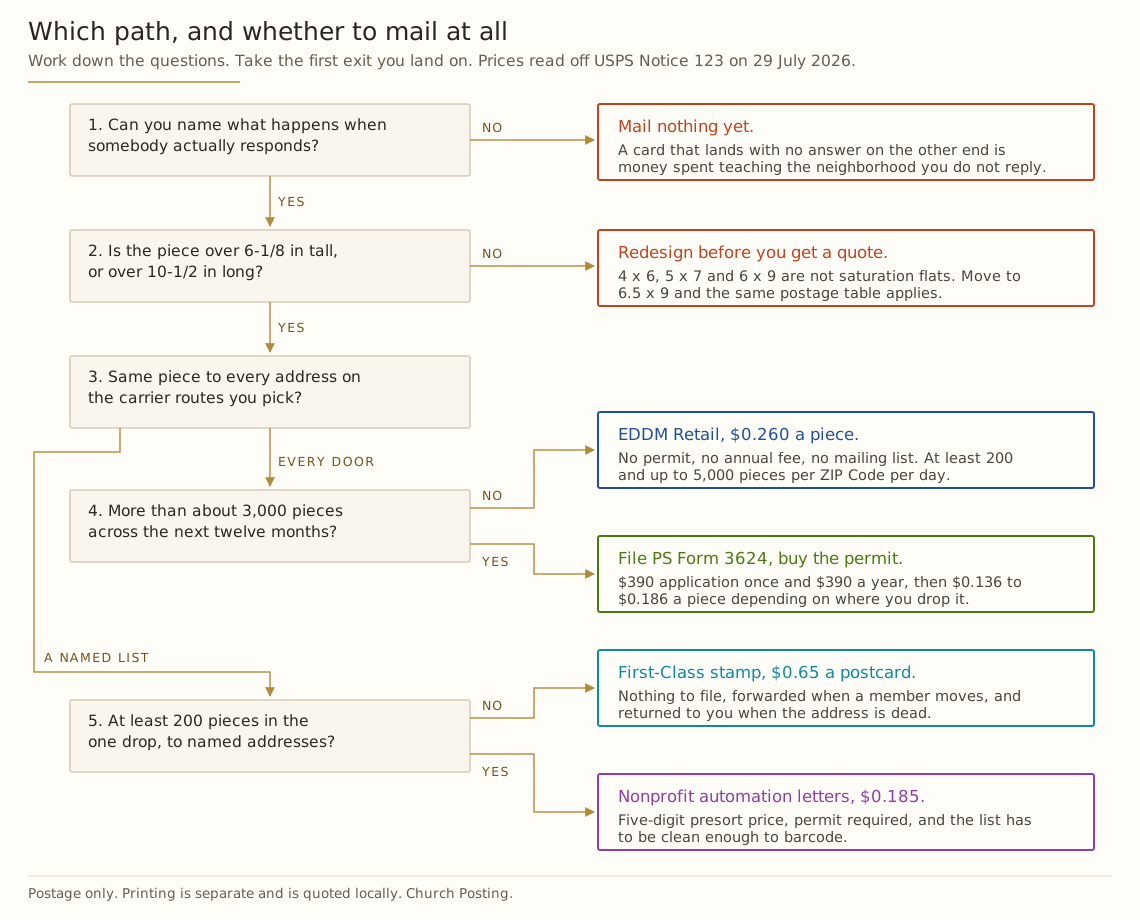
Every Door Direct Mail Retail costs $0.260 a piece for a flat weighing up to 3.3 ounces, with no permit and no mailing list. A church authorized to mail at Nonprofit USPS Marketing Mail prices pays $0.186 for the same piece handed in at any Post Office, or $0.136 if it delivers the bundles to the unit that serves the route. Printing is separate.
The retail figure is confirmed twice. The EDDM product page states “EDDM Retail USPS Marketing Flats currently $0.26 per piece” and the business prices page links the same $0.26 straight into Notice 123, where the line reads “EDDM Retail Flats up to 3.3 oz. $0.260” (all three checked 29 July 2026).
The nonprofit figures sit in a table most people never open. Notice 123 carries two flats tables that look identical and are not. In the commercial one, a carrier route saturation flat under four ounces costs $0.309 at any Post Office, $0.268 at the sectional center, and $0.259 at the delivery unit. That last number is the “as low as $0.259 per piece” the EDDM page advertises for its permit-based option. In the nonprofit table, the same three columns read $0.187, $0.146 and $0.137. The addressed carrier route saturation rate, one tenth of a cent lower in each column, is $0.186, $0.145 and $0.136.
Those three columns are why the rates look inconsistent between articles. USPS charges less the closer you carry the mail to the mailbox. The column Notice 123 labels “None” is what you pay handing bundles to any Post Office. The second is the sectional center serving those ZIP codes. The third, abbreviated DDU, is the destination delivery unit: the building the carriers on those routes leave from. Every number below says which of the three it assumes.
- EDDM Retail $0.260 a piece, no permit and no annual fee
- Nonprofit, DDU $0.136 a piece plus $390 a year, bundles carried to the delivery unit
- Nonprofit, none $0.186 a piece plus $390 a year, handed in at any Post Office
- Commercial, DDU $0.259 a piece plus $390 a year, the permit path without the nonprofit authorization
Per-piece prices and both fees read off USPS Notice 123, effective 12 July 2026, on 29 July 2026. Printing is not in these numbers. The three permit paths include the $390 annual mailing fee but not the one-time $390 permit application, which lands only in the first year.
See the numbers
| Vendor | 500 people | 1,000 people | 2,000 people | 3,000 people | 5,000 people | 10,000 people |
|---|---|---|---|---|---|---|
| EDDM Retail | $130 | $260 | $520 | $780 | $1,300 | $2,600 |
| Nonprofit, DDU | $458 | $526 | $662 | $798 | $1,070 | $1,750 |
| Nonprofit, none | $483 | $576 | $762 | $948 | $1,320 | $2,250 |
| Commercial, DDU | $520 | $649 | $908 | $1,167 | $1,685 | $2,980 |
Read the shape rather than the lines. Below about three thousand pieces a year the retail path is cheapest by a wide margin, because the fixed fees swamp the per-piece saving. Above it the nonprofit path pulls away and never comes back. The commercial permit path is the worst of all four at every volume on the chart, which is worth saying plainly: if your church has 501(c)(3) recognition and somebody sold you a bulk permit without filing the nonprofit application, you are paying $390 a year for a rate that is a tenth of a cent better than walking in off the street.
Where the permit pays for itself: 3,145 pieces
The annual mailing fee for USPS Marketing Mail is $390 per twelve-month period, and the one-time application fee to use permit imprints is also $390. Both figures come from the Domestic Business Mailing Fees table in Notice 123. Two different fees, the same number, which is how churches end up budgeting for one and getting billed for two.
Domestic Mail Manual 243 settles one useful detail: when postage is paid by permit imprint, “only one annual mailing fee, paid at the Post Office of account where the permit-imprint account is held, is required, regardless of the number of Post Offices of mailing.” So a church mailing into three ZIP codes pays $390, not $1,170. The same section confirms the annual fee “is in addition to the one-time fee for an application to use permit imprints.”
Now the arithmetic. Against EDDM Retail at $0.260:
| Path | Saving per piece | Break-even, ongoing year | Break-even, first year |
|---|---|---|---|
| Nonprofit saturation flats, delivered to the unit | $0.124 | 3,145 pieces | 6,290 pieces |
| Nonprofit saturation flats, any Post Office | $0.074 | 5,271 pieces | 10,541 pieces |
| Commercial saturation flats, delivered to the unit | $0.001 | 390,000 pieces | 780,000 pieces |
Two mailings of 1,500 households, which is what Christmas and Easter done properly looks like, lands almost exactly on the first break-even and about half of the first-year one. That is the real decision point, and it is nowhere near the volumes the printing industry talks about.
One caveat the table hides. The $0.124 is bought by driving the bundles to the unit that serves those routes, which in a small town is the building you were going to anyway and in a metro area is a scheduled forty-minute round trip. The $0.186 column is the honest one for a church that will not organize that trip.
The size rule that quietly disqualifies a 6 by 9 postcard
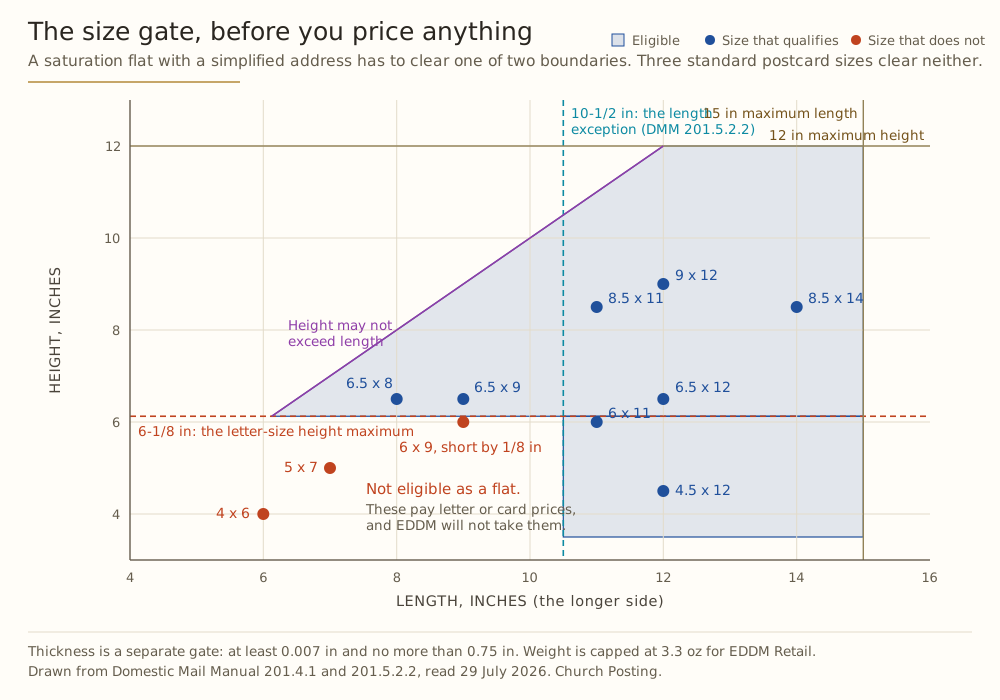
To ride the saturation flat rate with a simplified address, a piece has to be a flat. Domestic Mail Manual 201.4.1 defines flat-size mail as more than 11.5 inches long, or more than 6.125 inches high, or more than a quarter inch thick, with a ceiling of 15 by 12 by 0.75 inches. Section 201.5.2.2 adds one exception for simplified-address pieces: the length may be shorter than the letter maximum provided it is greater than 10.5 inches, the height is between 3.5 and 12 inches, and the height does not exceed the length.
Put those two rules on one pair of axes and the standard postcard sizes sort themselves.
Three consequences worth knowing before you brief a designer.
A 4 by 6 or 5 by 7 card cannot be mailed this way at all. Those are card-size pieces. They will go First-Class on a stamp at $0.65 each and they will not go through EDDM.
A 6 by 9 card fails by one eighth of an inch. Six inches high is under the 6.125 letter maximum, and nine inches long is under the 10.5 exception. Order 6.5 by 9 and the entire postage table above applies to it. This single measurement is the most expensive mistake available on this subject, because it is only discovered at the counter.
A 6 by 11 card qualifies, but it needs an extra marking. Its length clears the 10.5 exception while the piece still sits entirely inside letter-size dimensions, and 201.5.2.2 requires those pieces to carry an “EDDM” marking directly after the “ECRWSS” line. A 6.5 by 9 or a 4.5 by 12 exceeds a letter dimension outright and needs no such marking. Printers doing this every week get it right. A church printing its own does not.
Thickness is a separate gate, at least 0.007 inch and no more than 0.75 inch, which means 14 point cardstock or heavier. The EDDM page also fixes the indicia block: larger than 0.5 by 0.5 inch, all caps, at least 4 point type.
How does a church get the nonprofit mail rate?
File PS Form 3624 with the Post Office where the mailings will be deposited. There is no fee for the form. Domestic Mail Manual 703 puts churches squarely in the religious category: an organization whose primary purpose is to “conduct religious worship (e.g., churches, synagogues, temples, or mosques).”
Four details on that form matter and none of them appear in the articles about church mailers.
A 501(c)(3) letter helps and is not required. Section 703.1.7.4 wants evidence that the organization meets a qualifying category and is nonprofit, then states that an income tax exemption “is not required to qualify for the Nonprofit USPS Marketing Mail prices. Such exemption is considered as evidence of qualification for preferred postal prices, but is not the controlling factor in the decision.” Churches are exempt under federal tax law without applying, so many hold no determination letter. Send the articles of incorporation, the constitution, the bylaws, and a recent annual report showing what the congregation does.
A responsible official signs it, not your printer. PS Form 3624 states on its instruction page that the applicant “must be a responsible official of the organization” and that “printers and mailing agents may not sign for the organization.” A full-service EDDM vendor cannot do this step for you.
You can start mailing before it is approved. Section 703.1.9 lets an organization with a pending application mail at regular prices while USPS records the difference, and refund that difference “since the effective date of the authorization.” Section 703.1.9.4 sets that date as the day you applied or the day you became eligible, whichever is later. So the form goes in first, before the design and before the print quote. It costs nothing and it turns the approval wait into a bookkeeping entry.
A denial is appealable in fifteen days. Section 703.1.10.3 gives fifteen days from receipt of the decision to appeal in writing to the postmaster where the application was filed. Mark the date the day the letter arrives.
Four ways a church loses the nonprofit rate after it has it
The authorization is not a discount card. It is permission to mail the organization’s own matter, and DMM 703 spends several thousand words on what that excludes. These four come up in real church mailings.
The name on the card has to be the name on the authorization. Section 703.1.5 requires that “the name and return address of the authorized nonprofit organization must be either on the outside of the mailpiece or in a prominent location on the material being mailed,” and that “if the piece bears any name and return address, it must be that of the authorized nonprofit organization.” Pseudonyms are named and prohibited. A congregation legally incorporated as one thing and publicly branded as another has a decision to make before the card goes to press, not after.
You cannot lend the permit. Section 703.1.6.1: an authorized organization “may mail only its own matter at those prices” and “may not delegate or lend the use of its authorization to mail at the Nonprofit USPS Marketing Mail prices to any other person or organization.” A church that offers to run a mailing for the Christian school down the road, or for a church plant that has not filed its own form, is outside the rule.
A shared card is a cooperative mailing. Section 703.1.6.3 requires every cooperating organization in a cooperative mailing to hold its own authorization at the Post Office of deposit. Any mailing carrying matter on behalf of an unauthorized organization “must be paid at the applicable regular USPS Marketing Mail prices.” Three churches splitting the cost of one community-wide Christmas card need three authorizations at that office, or they pay $0.309 instead of $0.186.
Selling space on the card can disqualify it. Section 703.1.6.4 bars nonprofit prices for material advertising credit or charge cards, insurance policies, travel arrangements, and “any other product or service” unless the sale is substantially related to the purpose the organization qualified under. Announcements of activities such as a bake sale or a car wash are treated as substantially related when “substantially all the work is conducted by the members or supporters of an authorized organization without compensation.” So the fall festival announcement is fine. The local restaurant’s coupon printed on the back to defray printing is not.
None of this makes the nonprofit rate risky. It makes it a rate with rules, and every rule above is checkable in one page of the manual.
What EDDM will not let you do
The retail program buys geography, not a list. Four constraints follow from that and they shape what you can promise the elders.
Complete coverage of a route, or nothing. The simplified address exists because the mail goes to every active delivery. DMM 602.3.2 requires the address “Postal Customer” when distribution is intended to all active deliveries on a designated city route, and allows “Residential Customer” for residential addresses only. There is no version where you skip the apartment block or send only to houses with children.
Two hundred to five thousand pieces per ZIP code per day. The EDDM page states both limits for the retail option and adds “no special mailing permit needed.” A church wanting eight thousand pieces into one ZIP code splits the drop across days or moves to the permit path, where there is no ceiling.
Demographic filters select routes, not households. The EDDM Online Tool filters by route, residential count, total count, age, household size, income and cost, and its own footnote says that data “is based on prior report of the U.S. Census Bureau.” Those are route averages. A route with a high average household size does not deliver only to families, and a proposal implying otherwise is overselling the tool.
You do the physical work. Bundles of 50 to 100 pieces, none taller than six inches, a facing slip on top of each with the count written on it, boxed, and carried to the office named on the order. Budget two people and about an hour per thousand pieces, and put the date on the calendar before the cards arrive rather than after.
Which routes to buy at all is the harder question. Reaching a neighborhood without growth-industry tactics is the work that comes before a single route is selected.
What response rate should a church expect?
Nobody publishes one. We looked for a church-specific direct mail response rate in this run and found no source worth citing, so this page quotes no number as if it were measured. What is available is vendor marketing: the Lob State of Direct Mail library page promises that “Response rates soar to 27% when direct mail and email are combined” (read 29 July 2026), which describes an existing customer list being emailed and mailed at once. It has no bearing on a card landing with a stranger who has never heard your church’s name.
Plan against a range instead, and do the division yourself. Postage only, before printing:
| Response rate | Responses per 1,000 pieces | Cost per response at $0.260 | Cost per response at $0.136 |
|---|---|---|---|
| 1.00 percent | 10 | $26.00 | $13.60 |
| 0.50 percent | 5 | $52.00 | $27.20 |
| 0.25 percent | 2.5 | $104.00 | $54.40 |
| 0.10 percent | 1 | $260.00 | $136.00 |
| 0.05 percent | 0.5 | $520.00 | $272.00 |
The table is the argument. The assumption you cannot verify moves the answer by a factor of twenty, and everything else on this page moves it by a factor of two. That is why a church that mails without counting learns nothing, and why the first mailing is worth doing partly to find out where in that column you actually sit.
Two more corrections. A response is not a visitor: somebody scanning the code or calling the office is one step, and a person in a room on a Sunday is the next one. And a household is not a person. Five hundred households on a route is five hundred mailboxes, most of them emptied standing up next to a recycling bin. Average attendance hides whether your church is growing or shrinking sets out the counting method, and the four numbers to write down after a mailing are in the spreadsheet at the end of this page.
Cost per household against a Facebook ad
One EDDM Retail piece delivered costs $0.260 in postage, so a thousand delivered pieces cost $260.
WordStream’s 2025 Facebook ads benchmarks, drawn from more than a thousand campaigns and last updated 15 September 2025, reports an average cost per click of $0.70 and an average click-through rate of 1.71 percent across all industries for traffic campaigns. In the Education and Instruction row, the closest published category to a church, it is $0.86 per click at a 1.45 percent click-through rate. A 1.45 percent click-through rate means about 69 impressions per click, so $0.86 buys 69 impressions, which works out to roughly $12.47 per thousand impressions.
$260 per thousand mailboxes against $12.47 per thousand impressions. Paid reach is about twenty times cheaper per exposure and it is not close.
That comparison is doing work you should see. An impression is one scroll past a feed, possibly the same person four times in a week, skippable in a quarter of a second. A card is an object in the kitchen that has to be picked up to be thrown away. Nobody has a clean exchange rate between those two, and any page that gives you one is guessing.
Where the numbers do meet is a name collected. The same report puts the average Facebook cost per lead at $27.66 against a 7.72 percent conversion rate. Look back at the response table: $27.66 sits between the 0.50 and 1.00 percent rows of the nonprofit mailing and beats every row of the retail mailing except a 1 percent response nobody should assume. On price per name, paid social wins at the volumes a church works with.
One line item churches keep leaving on the table. Google Ad Grants gives a qualifying nonprofit “up to $10,000 per month in search ads shown on Google.com.” Google’s eligibility page requires 501(c)(3) registration and validation through its partner Goodstack, and names three ineligible categories: governmental entities, hospitals and health care organizations, and schools and academic institutions. Religious organizations are not on that list. Search ads answer somebody already typing “church near me” at eight on a Saturday night, and the budget is free. Do that before you spend $1,200 on cardstock.
When a postcard genuinely beats a Facebook ad
Five conditions. Mail wins when at least three of them hold, and when none of them hold you are buying paper.
The building is invisible and the neighborhood is walkable. A church set back from the road, inside an industrial park, or sharing a school gym has an information problem that geography solves and targeting does not. A card that says where the door is, on the streets within walking distance, does something an ad cannot.
You are announcing a date, not an identity. Christmas Eve at 5 and 7, Easter at 9 and 11, a Vacation Bible School week with the ages and the dates. A single fact with a deadline survives the trip from the mailbox to the refrigerator. A card about who your church is does not.
The routes overlap your members’ actual streets. Mail where the congregation already lives and every card is backed by somebody who can answer a question about it. Mail into a subdivision where nobody in the church knows a soul and the card is the whole relationship.
Your audience is over sixty-five or off social platforms. The people you cannot reach any other way are the people mail was always for. That reason alone justifies a small drop into two or three routes.
Something has changed that a stranger would care about. A new service time, a move to a new building, a reopened food pantry, a first service. News is worth mailing. Existence is not, and a card that amounts to “we are still here on Sundays” earns the response rate it deserves.
If none of those hold, the money buys more reach elsewhere. A church social media strategy that survives the volunteer covers the free half of that, and church texting services priced at 120, 300, 900, and 3,000 people covers what per-contact messaging costs once somebody has given you a number.
What goes on the card
One job. A card with a service time, a small group invitation, a giving appeal and a building update has no job. Pick the one thing you would still print if the card had room for nothing else.
Six things on the front and back, in this order of importance. The date and start time. The street address, written the way a stranger would key it into a phone. What actually happens, in one sentence, without inside language. The church name and return address exactly as they appear on the nonprofit authorization. One way to reach a human. One photograph of the room or the door, not of an unrelated smiling family.
A URL a person can retype, next to a code they can scan. A code alone is useless when the phone is in the other room, and a card in a kitchen gets read hours after it is picked up. Point both at a page naming the same date and time as the card, and if that page does not exist, build it before the print order goes in.
Type big enough to read standing up. Set the date and the time at a size a sixty-five-year-old reads at arm’s length without glasses. The copyright and accessibility rules for printed church material apply to a mailer exactly as they apply to a bulletin, including the rule about which hymn text or image you may reproduce.
Leave off the mission statement, the staff list, the doctrinal statement, and any word that needs a church background to parse. None of them survive four seconds. A piece going to members rather than strangers can carry more, which is the case when a congregation is communicating a building project.
And the rule that makes the rest worth doing: somebody answers. A card that produces a phone call nobody returns is worse than no card, because it teaches a neighbor something true about the church. A guest follow-up system one volunteer can run has to exist before the mailing, not after it.
Christmas and Easter: count backward, not forward
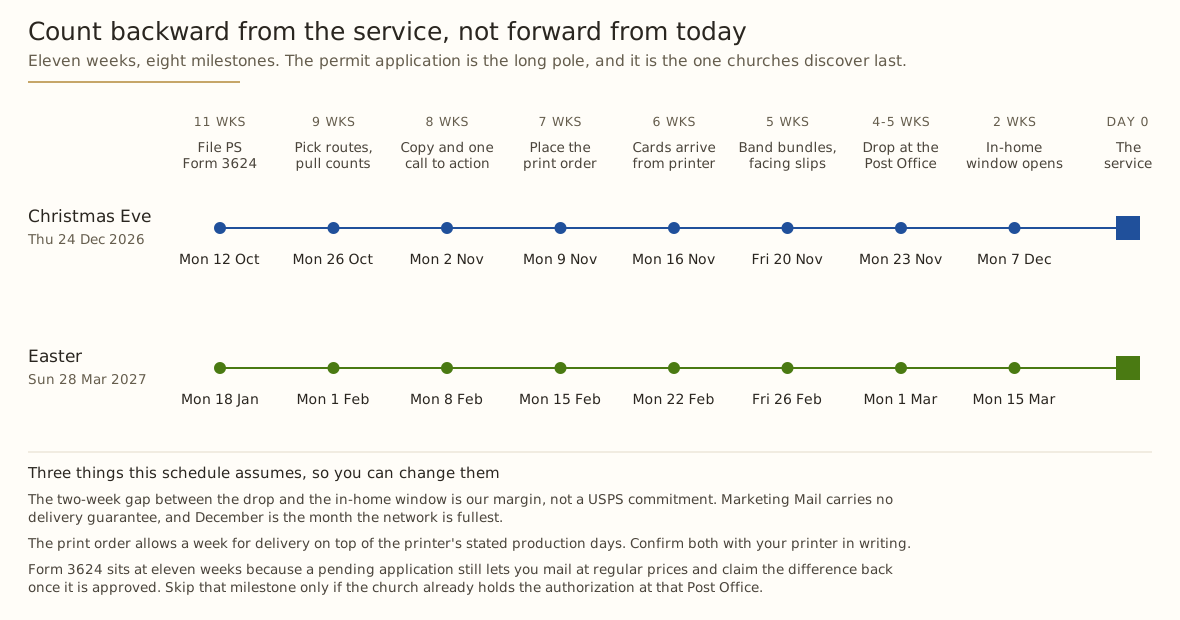
Christmas Eve 2026 falls on Thursday 24 December. Easter 2027 is Sunday 28 March, with Palm Sunday on 21 March. Working backward from each of those, with the permit application at the far left because it is the milestone churches discover last:
Three timing decisions inside that schedule.
Land the card two Sundays before the service, not the week of it. A card that arrives on 22 December is competing with every other envelope in the house at the worst possible moment, and a family that would have come has already decided. Two Sundays out gives the card time to be moved to the refrigerator and gives a member time to mention the same date in person.
Mail before Advent begins, not during it. Advent starts on Sunday 29 November 2026. Drop the Christmas mailing the week before, so the card is in the house while the season is still being planned around.
Easter is early in 2027 and it will catch churches out. 28 March is nine days earlier than Easter 2026 was, which pulls the whole schedule into January. Ash Wednesday is 10 February 2027. If your practice is to plan the Easter mailing after the new year, in 2027 that leaves five weeks, and five weeks is not enough to file a permit application. Put the January dates in a calendar now. The seasonal dates for the rest of the year sit in one hour a month builds a church content calendar a volunteer can hold.
What we could not price, and why
No printing cost appears anywhere on this page, and that is a gap rather than an oversight. Two EDDM printers publish real specifications. PrintPlace lists full-service EDDM postcards at 6.5 by 9, 6.5 by 8, 8.5 by 11 and 6.5 by 12 inches, on 14 and 16 point cardstock, in quantities from 100 to 50,000, with one to four business days of print time and “no mailing list or postage permit required.” Primoprint lists sizes from 4.5 by 12 up to 9 by 12, run sizes from 100 to 25,000 for print-only orders, and a $150 design fee if you hire its designers. Both put every dollar figure behind a JavaScript calculator that returns nothing to an automated request, as did every other EDDM printer we tried on 29 July 2026.
A wrong price about a real company is worse than no price. Get two quotes for the trim size and quantity you settled on, ask each printer to state the postage separately from the printing, and add the per-piece print figure to the rate card in the spreadsheet below. That is the one number you have to supply yourself, and it is the one a local relationship actually moves.
Take the schedule and the model with you
The postage rate card and cost model is a spreadsheet in six blocks: thirteen rows of per-piece postage covering nonprofit and commercial flats and letters at every entry point, the four fees with how often each is charged, annual postage at six volumes for five paths, the three break-even calculations, the cost-per-response grid at five response rates, and four empty rows for the numbers you write down after the mailing. Every rate carries the Notice 123 section it came from. Printing is deliberately blank.
The backward calendar as an .ics file puts all eighteen milestones into your own calendar as all-day markers: the eight for Christmas Eve 2026, the eight for Easter 2027, a yearly reminder that the $390 annual mailing fee is due with the break-even figure attached to it, and one six weeks after the Christmas drop that says to write down the four numbers before deciding about Easter.
So what should you do
Under 3,000 pieces a year, or you are not sure yet. Use EDDM Retail. $0.260 a piece, no permit, no annual fee, 200 to 5,000 per ZIP code per day. Order 6.5 by 9 cards. Mail two or three routes where members already live, land them two Sundays before Christmas Eve, and count the four numbers. Total postage on 1,500 pieces is $390, which is a coincidence worth noticing: it is exactly the annual fee you did not pay.
Over 3,000 pieces a year, or you intend to be. File PS Form 3624 this month, before you have designed anything. It costs nothing, a pending application still lets you mail and claim the difference back, and the effective date runs from the day you file. Then buy the permit, and plan to drive the bundles to the delivery unit rather than the nearest counter, because that trip is where $0.124 a piece lives.
Mailing a list of members rather than a neighborhood. Under 200 pieces, use First-Class stamps at $0.65 and stop thinking about it. Over 200 with the permit in hand, nonprofit automation letters run $0.185 at five-digit presort, and the list has to be clean enough to barcode, which is a data problem before it is a postage problem.
No follow-up, or no way to say what happened. Mail nothing this season. Spend the $1,200 on the two things that make the next mailing work: a named person who answers within seventy-two hours, and a page on your own site that says the same date the card will say. Then mail in the spring with a number to compare against.
The reason this decision is worth ten minutes of arithmetic is that mail is one of the few places a church spends real money on strangers. Getting the rate right saves a few hundred dollars. Getting the question right, which is whether anybody is going to answer the phone, saves the whole budget.
Sources
Every figure above was read off these pages on the dates given.
- USPS Notice 123, Price List, United States Postal Service, effective 12 July 2026, read 29 July 2026. All per-piece postage, the $390 annual mailing fee, and the $390 permit imprint application fee.
- Every Door Direct Mail, United States Postal Service, read 29 July 2026. The $0.26 retail rate, the “as low as $0.259” permit rate, the 200 to 5,000 per ZIP code per day limits, the bundling and facing slip rules, the indicia size, and the Census basis of the demographic filters.
- USPS business prices, United States Postal Service, read 29 July 2026. Confirmation of the $0.26 EDDM Retail rate and the $0.227 commercial Marketing Mail floor.
- Domestic Mail Manual 243, Prices and Eligibility, United States Postal Service, read 29 July 2026. The 200-piece minimum, the rule that nonprofit prices require authorization under 703, and the one-annual-fee-per-permit rule.
- Domestic Mail Manual 703, Nonprofit USPS Marketing Mail, United States Postal Service, read 29 July 2026. The religious category definition, Form 3624 and its lack of a fee, the evidence requirements, the identification rule, the own-matter rule, cooperative mailings, the advertising prohibitions, mailing while pending, the refund, and the fifteen-day appeal.
- Domestic Mail Manual 201, Physical Standards, United States Postal Service, read 29 July 2026. Flat-size definitions and the simplified-address dimension exception in 201.5.2.2.
- Domestic Mail Manual 602, Addressing, United States Postal Service, read 29 July 2026. The simplified address formats and the complete-distribution requirement.
- PS Form 3624, Application to Mail at Nonprofit USPS Marketing Mail Prices, United States Postal Service, January 2017 revision, read 29 July 2026. No application fee, the responsible-official signature rule, and the pending-mailing refund statement.
- Facebook Ads Benchmarks, WordStream, last updated 15 September 2025, read 29 July 2026. Cost per click, click-through rate, conversion rate and cost per lead.
- Google Ad Grants, Google, read 29 July 2026. The $10,000 per month search advertising figure.
- Google for Nonprofits eligibility, Google, read 29 July 2026. The 501(c)(3) requirement, Goodstack validation, and the three ineligible categories.
- State of Direct Mail, Lob, read 29 July 2026. Quoted as an example of a vendor response-rate claim, not as evidence.
- EDDM Postcards, PrintPlace, read 29 July 2026. Sizes, stocks, quantities and print times.
- EDDM Postcards, Primoprint, read 29 July 2026. Sizes, run sizes and the design fee.
One claim was cut for want of a source. We could not find a church-specific direct mail response rate published by anyone who measured it, so this page quotes none and gives a range to plan against instead. If your church runs a mailing and counts the result properly, that measurement is worth more than anything currently in print on the subject.